20 Commonly Confused Words and How to Tell Them Apart

A school principal and a principle are only a few letters apart, but they mean different things. So do stationery for your desk and stationary for something that isn't moving. English has dozens of pairs like these: similar sounds or roots, different meanings.
These 20 commonly confused pairs turn up in work emails, academic reports, and everyday writing. Each pair below has a short definition, examples, and a memory trick to help you choose the word you mean.
20 commonly confused word pairs explained
1. Accept vs. Except
Accept is a verb meaning to take, receive, or agree to something. Except usually means excluding or but, and most often works as a preposition.
- Example 1: The review committee decided to accept the revised proposal without further objections.
- Example 2: Every member of the department arrived on time except the operations lead.
Memory trick: Accept starts with acc-, just like accumulate or access. Except starts with ex-, just like exclude or exit.
2. Affect vs. Effect
Affect is usually a verb: to influence or change something. Effect is usually a noun: the result of a cause.
- Example 1: The sudden drop in overnight temperatures will affect the setting time of the concrete.
- Example 2: The new onboarding schedule had an immediate positive effect on retention rates.
Memory trick: Remember the acronym RAVEN: Remember Affect is a Verb, Effect is a Noun.
3. Desert vs. Dessert
Desert, with a single s, means dry, barren land. As a verb, it means to abandon. Dessert, with a double s, is the sweet course at the end of a meal.
- Example 1: The field researchers packed extra drinking water before crossing the desert basin.
- Example 2: For dessert, the kitchen prepared fresh lemon custard topped with mint leaves.
Memory trick: Think of the two s letters in dessert as a second serving of sweets. A desert has only one s, a reminder of its scarce resources.
4. Envelop vs. Envelope
Envelop has no final e. It's a verb meaning to enclose, wrap, or cover completely. Add the e and you get envelope, the folded paper cover you put a letter in.
- Example 1: Thick fog began to envelop the coastline as the sun sank below the horizon.
- Example 2: Slip the signed contract into a sealed envelope before handing it to the courier.
Memory trick: Link the final e in envelope to the e in enclosure or letter.
5. Loose vs. Lose
Loose, with two o's, is an adjective meaning not tight, unfastened, or roomy. Lose, with one o, is a verb meaning to misplace something, fail to win, or be deprived of something.
- Example 1: A loose screw on the conveyor belt caused an intermittent rattling noise.
- Example 2: If we fail to secure the warehouse door, we might lose several pallets of inventory.
Memory trick: To spell lose, imagine you've lost one of the o letters in loose.
6. Principal vs. Principle
Principal can mean a person in charge, such as a school head, or an initial sum of money. A principle is a basic rule, standard, or moral truth.
- Example 1: The high school principal met with parents to discuss the updated academic calendar.
- Example 2: The engineering department refused to compromise on its core safety principle.
Principal also works as an adjective meaning primary, as the entry for principal in Wiktionary explains. Principle is always a noun.
Memory trick: The school principal is your pal (or the main person); a principle is a rule (both end in -le).
7. Stationery vs. Stationary
Stationery, with an e, means writing materials: paper, envelopes, and pens. Stationary, with an a, describes a person or thing that isn't moving.
- Example 1: The firm ordered bespoke letterhead from a local stationery supplier.
- Example 2: The delivery truck remained stationary at the loading dock until inspection finished.
The entry for stationery in Wiktionary lists writing materials as its meaning and traces it to stationer.
Memory trick: Stationery with an e is for envelopes, letters, and pens; stationary with an a is for staying at rest.
8. Beside vs. Besides
Beside means next to or at the side of, and it's a preposition. Besides adds something: it means in addition to, moreover, or apart from. It can be a preposition or an adverb.
- Example 1: Place the user manual beside the workstation so technicians can consult it.
- Example 2: Besides the initial investment cost, the committee evaluated ongoing maintenance fees.
Memory trick: The extra s in besides reminds you that you're adding something.
9. Cook vs. Cooker
A cook is a person who prepares food. Cook is also the verb for preparing it. In British English, a cooker is an appliance such as a stove or oven. Use cooker for the appliance, never the person.
- Example 1: The head cook prepared sixty hot breakfasts before the dining room doors opened.
- Example 2: The technician disconnected the gas supply before replacing the kitchen cooker.
Memory trick: The cook is the person standing on two feet; the cooker is an appliance built with metal and dials.
10. Current vs. Currant
Current, with an e, can refer to the present time or today's trends. It can also mean a flow of water, air, or electricity. A currant, with an a, is a small dried grape or tart berry used in baking.
- Example 1: Under current company guidelines, staff must complete security training once a year.
- Example 2: She folded a cup of dried currants into the dough before baking the tea buns.
Memory trick: A currant with an a is an edible berry, just like an apple.
11. Effective vs. Efficient
Something is effective if it produces the intended result. It's efficient if it gets that result with little wasted time, effort, or resources.
- Example 1: The revised filter design proved effective at capturing fine airborne dust particles.
- Example 2: An efficient routing algorithm reduced delivery driving times by twelve percent.
Memory trick: Link effective to the effect you want, and efficient to the effort you save.
12. Personal vs. Personnel
Personal relates to private life or an individual. It has one n, with the stress on the first syllable. Personnel means the employees or staff of an organization. It has a double n, and the stress falls on the final syllable.
- Example 1: Keep personal correspondence off company laptops during business trips.
- Example 2: All hospital personnel received badges granting access to the emergency wing.
Memory trick: Personnel has double n because it takes two or more persons to make a workforce.
13. Quite vs. Quiet
Quite is an adverb meaning completely, rather, or to a considerable degree. It has one syllable and ends in -te. Quiet has two syllables and ends in -et. As an adjective or noun, it refers to silence, peace, or low volume.
- Example 1: The final draft of the research paper is quite thorough and requires few edits.
- Example 2: The university library stays quiet during evening study periods.
Memory trick: In the word quiet, the letter e stays quietly enclosed between i and t.
14. Sensible vs. Sensitive
Sensible means practical, reasonable, or guided by common sense. Sensitive means perceptive, delicate, easily affected, or emotionally responsive.
- Example 1: Bringing an extra battery pack on a remote field trip is a sensible precaution.
- Example 2: Modern optical sensors are sensitive enough to register faint infrared reflections.
Memory trick: A sensible person relies on good sense; a sensitive instrument reacts to physical sensations.
15. Shade vs. Shadow
Shade is an area sheltered from direct sunlight and heat. A shadow is the dark shape you see when an object blocks light.
- Example 1: The construction crew rested in the shade of the building during the midday heat.
- Example 2: The tall radio mast cast a long shadow across the open field at dusk.
Memory trick: You sit in the shade to stay cool; you step on the dark shadow cast by your own body.
16. Conscience vs. Conscious
Conscience is a noun for your sense of right and wrong. Conscious is an adjective meaning awake, aware, or alert to your surroundings.
- Example 1: Her conscience would not let her remain silent about the falsified test records.
- Example 2: The injured cyclist remained conscious and answered the paramedic's questions clearly.
Memory trick: Conscience contains science; link it to knowing right from wrong. The -ous ending in conscious points to an active mental state.
17. Dairy vs. Diary
Dairy starts d-a-i and refers to milk products or places that process milk. Diary starts d-i-a and means a personal journal or book of daily entries.
- Example 1: Consumers with lactose intolerance avoid dairy items such as cow milk and butter.
- Example 2: The naturalist kept a detailed diary of bird migrations throughout the winter season.
Memory trick: Dairy begins with da-, like daily milk. Diary begins with di-, like dialogue with yourself.
18. Device vs. Devise
A device, with a c, is an instrument, gadget, or machine. Devise, with an s, is a verb meaning to invent, formulate, or plan.
- Example 1: The laboratory uses an automated device to measure liquid samples rapidly.
- Example 2: Software architects must devise a robust protocol to handle unexpected server dropouts.
Memory trick: Like advice (noun with c) and advise (verb with s), device is the object and devise is the action.
19. Fair vs. Fare
Fair can mean equitable, just, or light-complexioned. As a noun, it can mean an exhibition. Fare is the price you pay for transportation or the food served at a table.
- Example 1: Both partners agreed that a fifty-fifty split of the project workload was a fair division.
- Example 2: Commuters must tap their travel cards before boarding to pay the bus fare.
Memory trick: You pay a fare to travel far.
20. Career vs. Carrier
Your career is your chosen profession or lifelong vocation. A carrier is a person, company, or vehicle that transports goods, people, or signals.
- Example 1: She built a rewarding career as an environmental analyst for municipal water boards.
- Example 2: The regional carrier delivered three crates of replacement parts to the workshop.
Memory trick: A career is a vocation you care about; a carrier carries freight, letters, and packages.
Worked Before and After editing examples
Each correction below changes only the confused word. The rest of the sentence stays the same.
Example 1: Resolving a verb and noun confusion
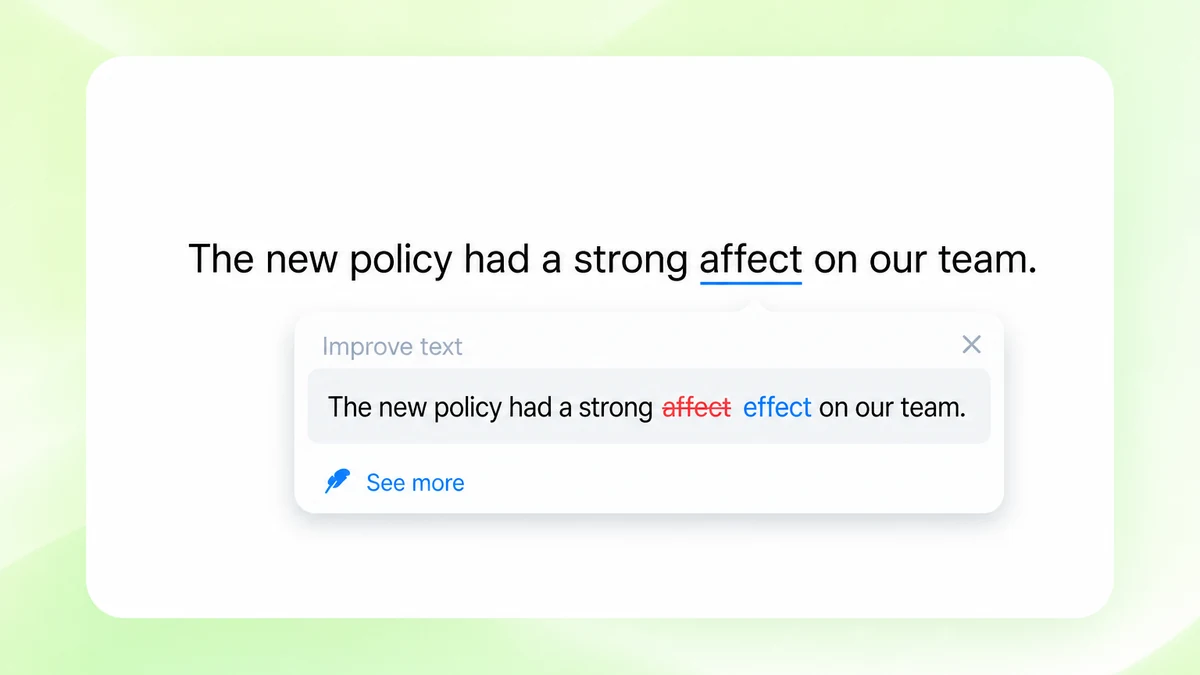
Before: The new policy had a strong affect on our team.
After: The new policy had a strong effect on our team.
Why this edit works: The words "a" and "strong" call for a noun. Effect means a result, while affect is usually a verb. The correction changes only the confused word.
Example 2: Distinguishing authority from ethical rules
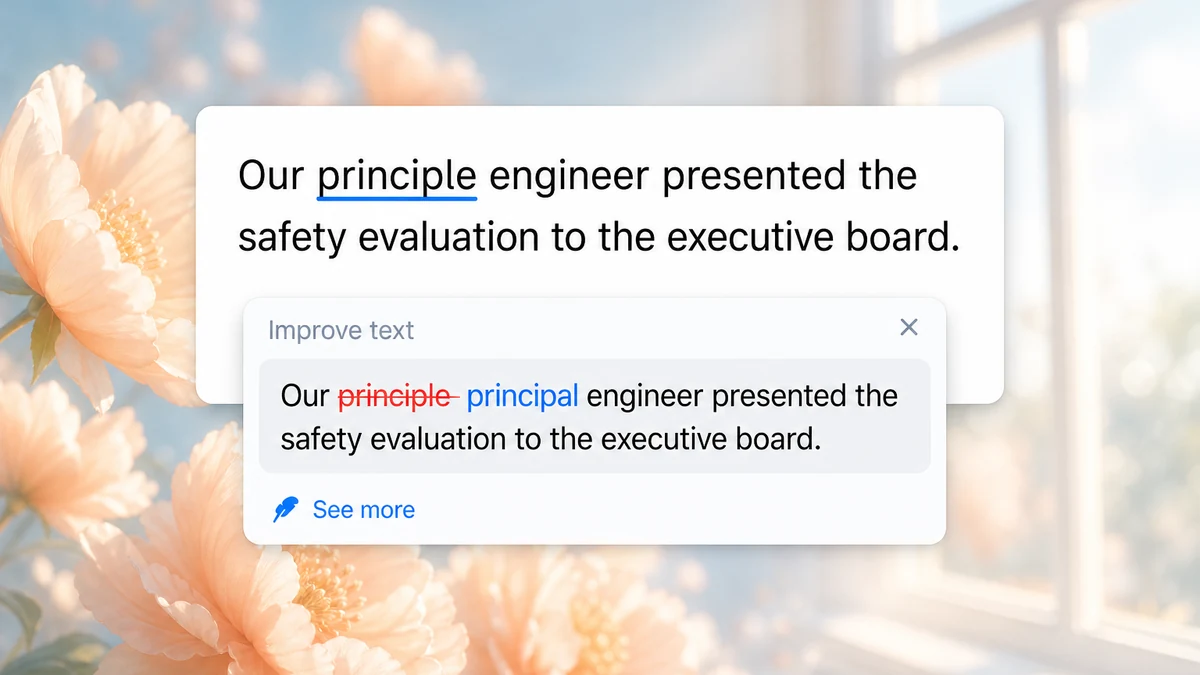
Before: Our principle engineer presented the safety evaluation to the executive board.
After: Our principal engineer presented the safety evaluation to the executive board.
Why this edit works: Principle is a noun meaning a doctrine, rule, or moral standard. The sentence requires the adjective principal, which denotes someone holding primary rank or leading importance.
Example 3: Correcting office supplies versus movement
Before: The procurement team purchased recycled paper from a local stationary merchant.
After: The procurement team purchased recycled paper from a local stationery merchant.
Why this edit works: Stationary with an a describes an object that remains at rest. Stationery with an e refers to writing paper, envelopes, and office goods. Changing the vowel aligns the spelling with the paper products described.
Example 4: Fixing adjective versus verb spelling
Before: Tighten the mounting bracket so the intake valve does not come lose during operation.
After: Tighten the mounting bracket so the intake valve does not come loose during operation.
Why this edit works: Lose with one o is a verb meaning to misplace or suffer a loss. The sentence requires the adjective loose with two o's to describe an unfastened mechanical component.
Step-by-step self-editing checklist
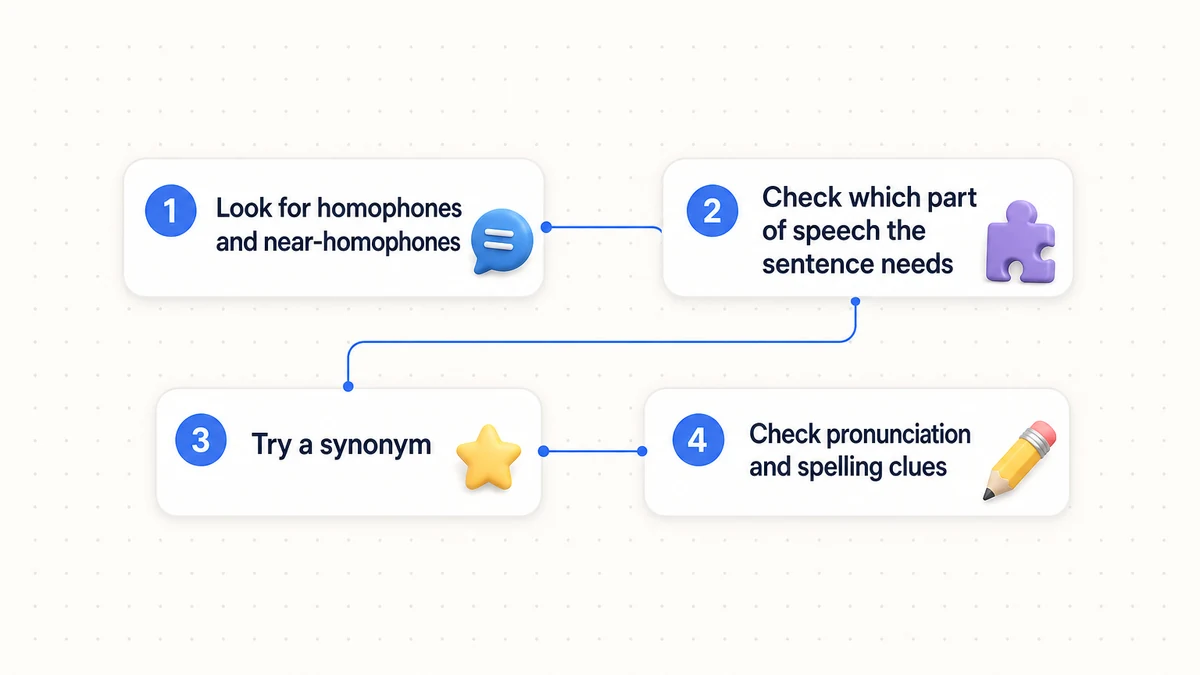
Use these four steps when you proofread your draft.
- Look for homophones and near-homophones, especially pairs you mix up: affect and effect, loose and lose, principal and principle.
- Check which part of speech the sentence needs: a noun, verb, adjective, or preposition. If you need a verb meaning to alter, use affect. For a noun meaning an outcome, use effect.
- Try a synonym. If rule fits, use principle. If primary fits, use principal. Use lose when you mean misplace, and loose when you mean unfastened.
- Check pronunciation and spelling clues. Look at endings such as -le and -al, or double letters such as the two s's in dessert and the double n in personnel.
If you're editing a work email, check the request as well as the word choice. Our guide to asking for a status update shows how to make that request clear.
Frequently asked questions about commonly confused words
Why do spellcheckers fail to catch commonly confused words?
A basic spellchecker checks whether a word appears in its dictionary. Affect, effect, principle, and principal all do, so it can accept them even when they don't fit the sentence. To catch that kind of error, a grammar checker needs to consider the surrounding words.
What is the difference between homophones and commonly confused words?
Homophones sound the same but differ in spelling and meaning. Stationary and stationery are homophones, as are fair and fare. Commonly confused words include those pairs, but also words with different final sounds, such as lose and loose. Others, such as effective and efficient, get mixed up because their meanings overlap.
How can non-native English writers remember these distinctions?
Learn each word's part of speech alongside its meaning. That gives you something to check beyond how it sounds: a device is a physical object, while devise is an action. Keep a list of pairs you find tricky and revisit the memory tricks as you write.
Are affect and effect ever interchangeable?
No. Affect has a rare use as a noun in psychology, where it describes emotional presentation. Effect can be a formal verb meaning to bring about change. Those exceptions don't make the words interchangeable. In everyday professional writing, the usual distinction still applies: affect is the verb and effect is the noun.
Catching confused words as you type
Catching a confused word while typing can prevent a misunderstanding. Wordfully is a Chrome extension with inline suggestions in Gmail, Google Docs, Slack, Notion, LinkedIn, and most other web apps. You can fix several grammar mistakes in a sentence with one click in the tooltip. Wordfully also explains its suggestions and shows definitions while you write. See the features page or the Wordfully AI writing assistant extension.