
How to Write an Email in Spanish: Complete Guide

Start a Spanish email by choosing how to address the reader: formal (usted) or informal (tú). Then write a clear subject line in sentence case, end the greeting with a colon, and state why you're writing. Carry the same level of formality through to the sign-off. Your verb forms, direct and indirect object pronouns, and possessive adjectives should all match that choice.
Some habits from English email writing don't carry over into Spanish. Greetings use different punctuation, requests often need polite indirect phrasing, and the words you use for "you" depend on your relationship with the reader. These details matter whether you're contacting an overseas client, applying to an academic program, or emailing a coworker in Madrid or Mexico City.
The core structure of an email in Spanish
A standard Spanish email has five parts: the subject line (el asunto), greeting (el saludo), opening context or purpose (la introducción), main request or explanation (el cuerpo), and closing with a signature (la despedida y firma). Give each part a clear job so the reader can find what they need.
The Purdue OWL email etiquette guide recommends a meaningful subject line, clear short paragraphs, directness, and a signature. Apply that advice to Spanish emails by putting the purpose near the top, keeping paragraphs manageable, and saying what should happen next.
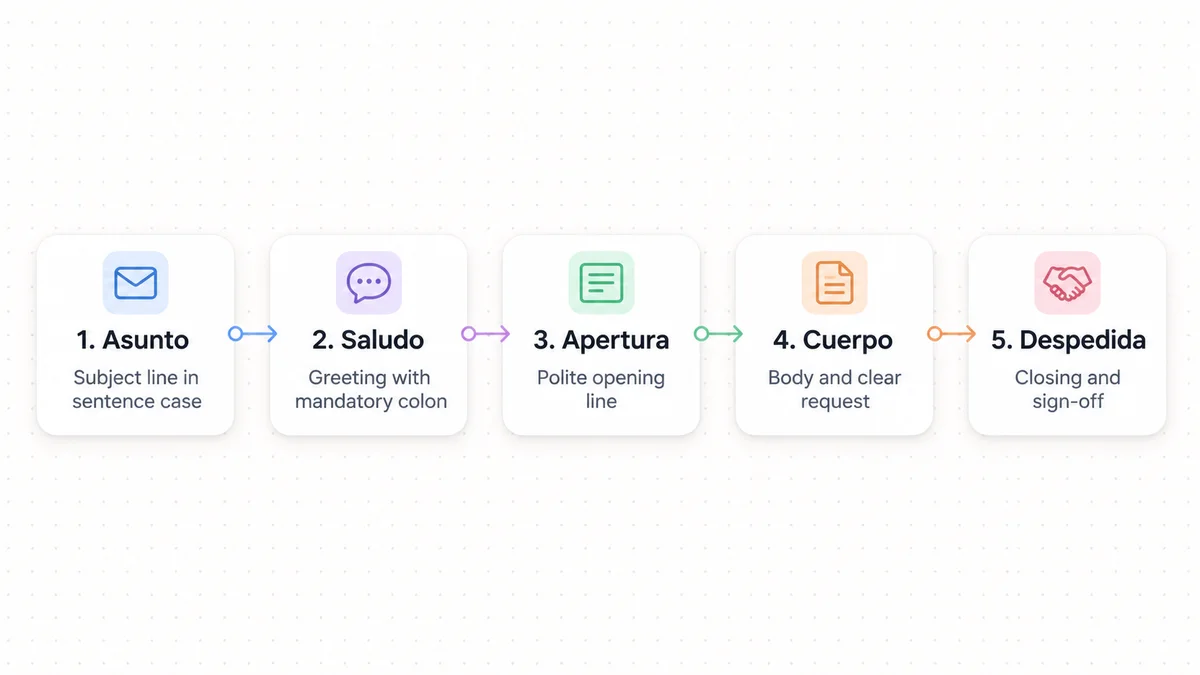
| Email element | Spanish name | Key requirement | Common example |
|---|---|---|---|
| Subject line | Asunto | Clear, concise, written in sentence case | Solicitud de presupuesto: Proyecto Alpha |
| Salutation | Saludo | Formality matched, ends with a colon | Estimado Sr. Morales: |
| Purpose opening | Apertura | States context and reason for writing | Le escribo para solicitar información sobre... |
| Body and request | Cuerpo | Cohesive paragraphs, softened requests | ¿Podría confirmarme la fecha de entrega? |
| Closing | Despedida | Register consistent with greeting | Saludos cordiales, |
Choosing your register: Usted vs. Tú
Choose between formal usted and informal tú before you start drafting. English uses "you" for everyone, whether you're writing to a peer or addressing a judge in a legal brief. Spanish makes that distinction in the grammar. Your choice affects verb conjugations, object pronouns, and possessive adjectives throughout the message.
When to use usted (formal register)
Use usted for people you don't know personally, corporate clients, senior executives, government officials, external suppliers, and university professors. It keeps a courteous professional distance.
The Universidad Nacional Autónoma de México communication manual asks students to give an email a clear subject, greet the recipient by name, include a closing, and reread it before sending. For a first business contact, start with usted if you're unsure. You can switch to informal terms later if the other person suggests it; starting too casually is harder to undo.
When to use tú (informal register)
Use tú with friends, family, immediate peers, close teammates, and colleagues you already know. Many modern technology companies and creative agencies in Spain and Latin America use tuteo, or addressing each other as tú, internally. Wait for the other person to use it first or say «nos podemos tutear» (we can use tú) before you switch.
The grammatical impact of your choice
Mixing usted and tú in the same message is an easy mistake to make. Although usted means "you," it takes third-person singular grammar, like él or ella. Keep its pronouns and verb endings separate from the second-person forms used with tú. The table below gives you the forms to check as you read through your draft.

| Grammatical element | Formal (Usted) | Informal (Tú) | English gloss |
|---|---|---|---|
| Present tense verb | Usted tiene | Tú tienes | You have |
| Conditional verb | Usted podría | Tú podrías | You could |
| Direct object pronoun | Lo / La | Te | You (accusative) |
| Indirect object pronoun | Le | Te | To you (dative) |
| Possessive adjective | Su / Sus | Tu / Tus | Your / Yours |
| Prepositional pronoun | Usted | Ti | You (after prepositions) |
| Imperative (command) | Escriba / Envíe | Escribe / Envía | Write / Send |
Subject lines in Spanish (El asunto)
Tell the reader what the email is about in the subject line. They shouldn't have to open it to find out. In Spanish business correspondence, vague subjects such as «Hola», «Consulta», or «Importante» often get delayed responses or end up filtered.
English subject lines often capitalize every major word. Spanish uses sentence case: capitalize the first word and proper nouns. Keep the subject brief enough to scan on a mobile screen.
Compare these examples:
- Vague: Pregunta sobre el proyecto
- Clear: Consulta sobre el presupuesto final del Proyecto Alpha
- Vague: Mi currículum
- Clear: Candidatura: Puesto de diseñador UX - Carlos Mendoza
- Vague: Reunión
- Clear: Convocatoria: Sesión de planificación trimestral (jueves 10:00)
- Vague: Información necesaria
- Clear: Solicitud de prórroga para la entrega del informe financiero
If your organization uses email priority tags, place them at the start in brackets: [URGENTE], [ACCIÓN REQUERIDA], or [INFORMACIÓN].
Salutations and greetings (El saludo)
Choose a greeting that fits your relationship with the reader, then check its punctuation. Spanish has specific spelling and punctuation rules for this part of an email.
The essential colon rule
English email greetings usually end with a comma, as in "Dear Mr. Davis,". Carrying that comma over into a Spanish greeting is an anglicism.
FundéuRAE on workplace correspondence explains that greetings in letters and emails end with a colon (:), never a comma. Start the body on a new line after the colon, with a capital letter.
There's also a comma within some greetings. If the person's name follows Hola or Buenos días, put a comma before the name. This separates the vocative, the person you're addressing, from the greeting:
- Incorrect: Estimado Juan,
- Correct: Estimado Juan:
- Incorrect: Hola Juan:
- Correct: Hola, Juan:
- Incorrect: Buenos días Sra. Gómez:
- Correct: Buenos días, Sra. Gómez:
Formal greetings
For a formal greeting, pair Estimado (or Estimada for a woman) with the person's title and surname:
- Estimado Sr. [Apellido]: (Dear Mr. [Last Name]:)
- Estimada Sra. [Apellido]: (Dear Ms. / Mrs. [Last Name]:)
- Estimado Dr. [Apellido]: / Estimada Dra. [Apellido]: (Dear Dr. [Last Name]:)
- Estimado Profesor [Apellido]: / Estimada Profesora [Apellido]: (Dear Professor [Last Name]:)
- Distinguido Sr. [Apellido]: (Distinguished Mr. [Last Name]:, used in very traditional or diplomatic correspondence)
If you don't have a contact name, or you're writing to a department or organization, use a general greeting:
- A quien corresponda: (To whom it may concern:)
- Estimados señores: (Dear Sirs / To the management team:)
- Estimado equipo de atención al cliente: (Dear Customer Support Team:)
Informal greetings
With peers, familiar colleagues, and personal acquaintances, you can use a warmer greeting:
- Hola, [Nombre]: (Hello [Name]:)
- Buenos días, [Nombre]: (Good morning [Name]:)
- Buenas tardes, [Nombre]: (Good afternoon [Name]:)
- Querido [Nombre]: / Querida [Nombre]: (Dear [Name]:, reserved for close personal friends or family)
- Hola a todos: / Estimado equipo: (Hello everyone: / Dear team:, for group emails to coworkers)
Opening courtesy lines and stating your purpose
A request can sound abrupt in Spanish if you start with a demand or question. A brief courtesy line gives you a polite way into the message before you explain what you need.
Formal courtesy openings
For a formal email, choose a short opening in the usted register:
- Espero que se encuentre muy bien. (I hope you are doing very well.)
- Espero que este mensaje le encuentre bien. (I hope this message finds you well.)
- Agradezco de antemano el tiempo dedicado a la lectura de este mensaje. (Thank you in advance for the time dedicated to reading this message.)
Then say why you're writing. Keep that purpose close to the opening so the reader doesn't have to search for it:
- Le escribo para solicitar más detalles sobre el proceso de selección. (I am writing to you to request more details about the recruitment process.)
- Me pongo en contacto con usted en relación con el contrato de servicios. (I am contacting you regarding the service contract.)
- El motivo de mi correo es presentarle nuestra propuesta de colaboración. (The purpose of my email is to present our collaboration proposal.)
Our guide on how to write a professional email has more advice on keeping that main message concise.
Informal courtesy openings
With tú, the opening can sound more like a conversation:
- Espero que estés muy bien y que hayas tenido una buena semana. (I hope you are doing well and had a good week.)
- ¿Cómo van las cosas? Te escribo rápidamente porque necesito pedirte un favor. (How are things going? I am writing quickly because I need to ask you a favor.)
- Gracias por tu respuesta de ayer. Te escribo para comentarte los últimos cambios. (Thanks for your reply yesterday. I am writing to update you on the latest changes.)
For more ways to keep work messages warm and clear, see how to make an email sound friendly.
Writing the email body: Key phrases and polite formulas
Use the body to explain the situation and ask for what you need. An imperative such as «Envíeme el archivo» can sound demanding. Conditional verbs such as podría and sería, or an indirect courtesy phrase, soften the request while keeping the action clear.
Polite requests and inquiries
- ¿Sería posible concertar una breve llamada esta semana? (Would it be possible to arrange a brief call this week?)
- ¿Podría usted confirmar la recepción de los documentos adjuntos? (Could you confirm receipt of the attached documents?)
- Le agradecería mucho si pudiera revisar el borrador antes del viernes. (I would greatly appreciate it if you could review the draft before Friday.)
- ¿Me podrías avisar cuando tengas un momento para revisarlo? (Could you let me know when you have a moment to review it? [Informal])
Referencing attachments
- Le adjunto el informe actualizado en formato PDF. (I attach the updated report in PDF format. [Formal])
- En el archivo adjunto encontrará el desglose detallado de costes. (In the attached file you will find the detailed breakdown of costs. [Formal])
- Te adjunto las notas de la reunión de esta mañana. (I attach the notes from this morning's meeting. [Informal])
- Comparto con usted el enlace al documento compartido. (I share with you the link to the shared document.)
Clarifications and answering questions
- En respuesta a su consulta sobre las fechas de entrega... (In response to your inquiry regarding the delivery dates...)
- Quedo a su total disposición para aclarar cualquier duda al respecto. (I remain completely at your disposal to clarify any questions in this regard. [Formal])
- Si necesitas más información, no dudes en escribirme. (If you need more information, do not hesitate to write to me. [Informal])
Closings and sign-offs (La despedida y firma)
Before you sign off, add a sentence about the next step in the conversation. Follow it with a closing that fits the rest of the email.
Pre-closing remarks
- Quedo a la espera de sus amables comentarios. (I look forward to your kind comments. [Formal])
- Agradeciendo de antemano su atención y colaboración, le saluda atentamente. (Thanking you in advance for your attention and cooperation, yours sincerely. [Formal])
- Cualquier consulta o aclaración adicional, no dude en hacérmela saber. (Any questions or additional clarification, please do not hesitate to let me know. [Formal])
- Hablamos pronto para coordinar los siguientes pasos. (We will speak soon to coordinate the next steps. [Informal])
- ¡Que tengas un excelente fin de semana! (Have a great weekend! [Informal])
Formal sign-offs
Put a comma after a formal sign-off, then leave space for your signature and professional contact details.
- Atentamente, (Sincerely / Yours faithfully)
- Saludos cordiales, (Kind regards / Best regards)
- Un cordial saludo, (A cordial greeting / Best regards)
- Cordialmente, (Cordially)
- Le saluda atentamente, (Yours faithfully, literally: He/she greets you attentively)
Be careful with «Sinceramente,». It means "honestly" or "frankly" in Spanish and is common in speech when someone wants to stress that they're telling the truth. It isn't the standard business closing that "Sincerely" is in English.
Informal sign-offs
- Un saludo, (Regards / Best)
- Un abrazo, (A hug / Warm regards, for people you know well)
- Un fuerte abrazo, (A big hug / Warmest regards, for friends or long-standing colleagues)
- Saludos, (Cheers / Regards)
- Nos vemos pronto, (See you soon)
The professional signature block
Include the professional details your reader needs to identify your role, organization, and contact information:
- [Nombre y Apellidos]
- [Puesto / Cargo profesional]
- [Departamento / Empresa]
- [Número de teléfono]
- [Enlace a sitio web o perfil profesional]
Worked Before and After examples
Examining authentic drafting mistakes shows how register confusion and literal translation harm an email.
Example 1: Resolving register collision
Here is a common draft that mixes formal and informal elements:
Before: Hola Juan, le escribo para pedirle los informes de ventas.
Analysis of errors: The sender opens with Hola Juan, which is an informal greeting addressing the recipient by first name. However, the writer then uses le escribo and pedirle, which are third-person singular formal clitic pronouns (le) reserved for usted. Furthermore, the greeting lacks the required vocative comma and ends with a comma instead of a colon.
After (Option A: Choosing the informal register for a colleague): Hola, Juan: Te escribo para pedirte los informes de ventas.
After (Option B: Choosing the formal register for a client or manager): Estimado Juan: Le escribo para pedirle los informes de ventas.
What changed: Option A aligns the entire sentence to the informal tú register by adding the vocative comma, replacing the comma with a colon, and changing le to te. Option B aligns the sentence to the formal usted register by using Estimado Juan: while preserving le.
Example 2: Softening demands and correcting punctuation
Here is a draft written by a non-native speaker translating literally from English:
Before: Estimada Marta, Enviame el reporte hoy mismo por favor. Gracias.
Analysis of errors: The greeting uses an English comma instead of a colon, and the text continues on the same line. The imperative command Enviame lacks an accent mark (Envíame) and sounds blunt. The sign-off Gracias is curt for a business message.
After: Estimada Marta:
¿Podría enviarme el reporte hoy, por favor?
Muchas gracias por su ayuda.
Saludos cordiales,
What changed: The revision corrects the greeting punctuation with a colon and moves the body to a new paragraph. It converts the blunt command into a polite conditional question (¿Podría enviarme...?) and adds a courteous sign-off. The usted verb form matches the respectful tone throughout.
If you find yourself following up on a delayed report, our guide on writing a follow-up email after no response provides strategies to prompt replies without sounding frustrated. You can also refer to our tips for writing a polite reminder email.
How translation and AI tools fit into Spanish email writing
Many professionals write an email in English first, then translate it into Spanish with machine translation or an AI writing assistant. The result can read fluently and still contain subtle mistakes. Leave time to check the Spanish before you send it.
Preparing clean source text
Ambiguity in an English draft can carry into the translation. Run-on sentences, idioms, and vague pronouns often lead to awkward Spanish phrasing or incorrect gender agreement. Clear up those problems in the English before translating.
An ai proofreader can help you check sentence structure, punctuation, and terminology in the English draft. A direct, unambiguous source gives the translation model a better chance of choosing the right Spanish terms.
Working inside your browser workflow
Switching between tabs to draft an email can interrupt your focus. An ai writing assistant inside Gmail or Google Docs lets you translate phrases, rephrase sentences, and adjust the draft's length without copying text back and forth.
Wordfully checks grammar, spelling, and punctuation in English in real time. Language models can help draft and translate Spanish, but Wordfully's automated grammar checking remains English-only. If you're writing in Spanish as a non-native speaker, review the wording and grammar yourself.
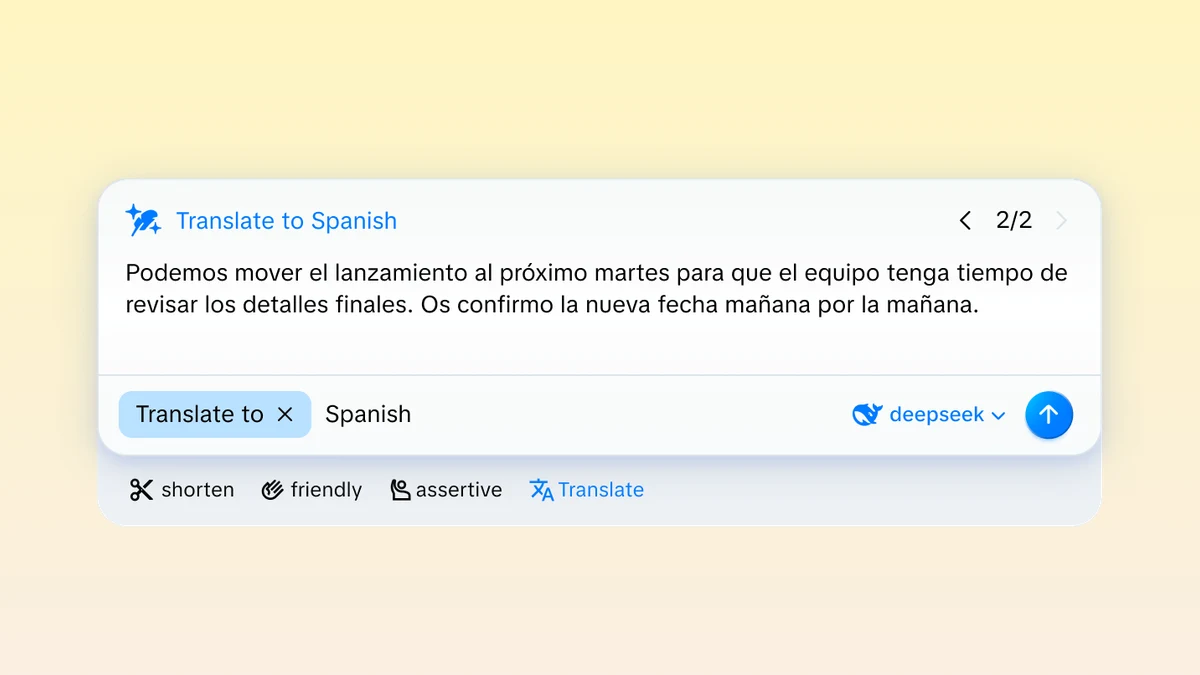
The post-translation verification checklist
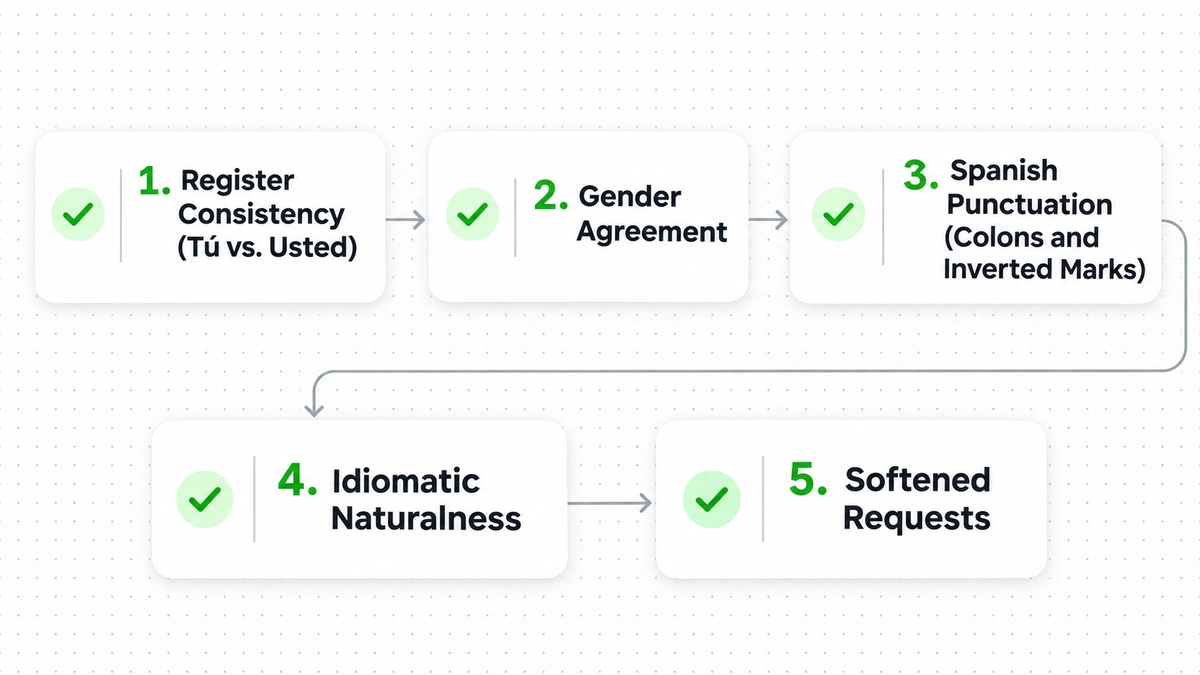
Check these five things in a machine-translated or AI-translated Spanish draft:
- Register consistency: Verify that the tool has not switched between tú and usted mid-paragraph.
- Gender agreement: Confirm that adjectives matching the recipient (estimado/estimada, atento/atenta) match their actual gender.
- Proper punctuation: Replace commas after greetings with colons, and add opening inverted question (¿) and exclamation (¡) marks where needed.
- Literal idioms: Watch out for translated idioms that make no sense in Spanish, such as translating "touch base" literally.
- Softened requests: Ensure demands use conditional verbs (¿podría?, le agradecería) rather than robotic imperatives.
Our guide on how to check an AI rewrite walks through reviewing an automated draft before you send it.
Four complete templates for common workplace scenarios
Choose a template that fits the email you need to send. Replace bracketed placeholders with your details and check that the rest of the message describes your situation.
Template 1: Formal inquiry to an institution or university
The Instituto Cervantes DELE B1 exam guide assesses whether letters and messages use a register that suits the context, including suitable greetings and closings. This template uses formal usted throughout.
Asunto: Solicitud de información sobre el programa de intercambio académico
Estimada Dra. Navarro:
Espero que se encuentre muy bien.
Mi nombre es Elena Vance y me dirijo a usted con el propósito de solicitar información sobre los requisitos de admisión para el programa de intercambio académico del próximo semestre de otoño.
En particular, le agradecería si pudiera facilitarme los siguientes detalles:
- Fechas límite para la presentación de candidaturas internacionales.
- Certificaciones de nivel de idioma requeridas para la matrícula.
- Procedimiento para la convalidación de asignaturas cursadas.
He revisado el folleto general publicado en el sitio web de la universidad, pero desearía confirmar si existen normativas específicas aplicables a estudiantes de último curso.
Agradezco de antemano su tiempo y atención. Quedo a su entera disposición para cualquier aclaración o entrega de documentación adicional.
Atentamente,
Elena Vance
Estudiante de Grado en Comunicación
Universidad del Norte
Teléfono: +1 (555) 019-2834
English gloss: Subject: Request for information regarding the academic exchange program. Dear Dr. Navarro: I hope you are doing very well. My name is Elena Vance and I am contacting you with the purpose of requesting information about the admission requirements for the academic exchange program for the upcoming fall semester. In particular, I would appreciate it if you could provide me with the following details: 1. Deadlines for the submission of international applications. 2. Language proficiency certifications required for enrollment. 3. Procedure for the validation of completed coursework. I have reviewed the general brochure published on the university website, but I would like to confirm whether there are specific regulations applicable to final-year students. Thank you in advance for your time and attention. I remain entirely at your disposal for any clarification or submission of additional documentation. Sincerely, Elena Vance.
Template 2: Formal business request for a quote or proposal
Asunto: Solicitud de presupuesto para servicios de desarrollo web
Estimado Sr. Castillo:
Espero que se encuentre bien.
Le escribo en representación del equipo de operaciones de Global Logistics con el fin de solicitar un presupuesto detallado para el rediseño de nuestra plataforma interna de gestión.
Adjunto a este correo encontrará el pliego de condiciones técnicas donde especificamos los requisitos funcionales del proyecto y los plazos previstos para su ejecución.
Agradeceríamos recibir su propuesta económica y cronograma estimado antes del próximo viernes a las 17:00 horas. Si requiere concertar una breve reunión virtual para resolver dudas sobre los requerimientos, quedamos a su entera disposición.
Agradeciendo de antemano su colaboración, le saluda atentamente,
David Ramos
Director de Operaciones
Global Logistics Corp.
david.ramos@globallogistics.example.com
Tel: +34 912 345 678
English gloss: Subject: Request for quotation for web development services. Dear Mr. Castillo: I hope you are well. I am writing to you on behalf of the operations team at Global Logistics in order to request a detailed quotation for the redesign of our internal management platform. Attached to this email you will find the technical specification document where we detail the functional requirements of the project and the anticipated execution deadlines. We would appreciate receiving your price proposal and estimated timeline before next Friday at 17:00 hours. If you need to arrange a brief virtual meeting to resolve questions regarding the requirements, we remain entirely at your disposal. Thanking you in advance for your cooperation, yours faithfully, David Ramos, Operations Director.
Template 3: Semi-formal email to a colleague or project collaborator
Asunto: Actualización de avance y convocatoria de reunión - Campaña Q1
Hola, Marcos:
Espero que estés teniendo una excelente semana.
Te escribo para compartir contigo los últimos resultados de la fase de pruebas de la campaña del primer trimestre. Como podrás comprobar en el resumen que te adjunto, el equipo ha completado las revisiones principales con un balance muy positivo.
¿Tendrías disponibilidad para reunirnos mañana jueves a las 11:30 durante media hora? Me gustaría revisar contigo dos puntos concretos:
- El calendario final de lanzamiento en redes sociales.
- La distribución de tareas para el equipo de diseño gráfico.
Si prefieres otro horario por la tarde, avísame y adapto mi agenda sin problema.
Muchas gracias por tu apoyo continuo con este proyecto.
Un cordial saludo,
Sofía Martínez
Coordinadora de Marketing
Extensión: 4021
English gloss: Subject: Progress update and meeting notice - Q1 Campaign. Hello Marcos: I hope you are having an excellent week. I am writing to share with you the latest results from the testing phase of the first-quarter campaign. As you will see in the summary attached, the team has completed the main revisions with a very positive outcome. Would you have availability to meet tomorrow, Thursday, at 11:30 for half an hour? I would like to review two specific points with you: The final social media launch calendar, and the task allocation for the graphic design team. If you prefer another time in the afternoon, let me know and I will adjust my schedule without issue. Thank you very much for your continuous support on this project. Kind regards, Sofía Martínez.
Template 4: Informal email to a teammate or work friend
Asunto: Información sobre el taller de formación de mañana
Hola, Clara:
¿Qué tal todo? Espero que hayas tenido un buen inicio de semana.
Te paso rápidamente este correo para recordarte que el taller de formación sobre nuevas herramientas comienza mañana a las 10:00 en la sala B.
El organizador nos pidió que lleváramos instalado el software en los portátiles antes de la sesión. Si tienes alguna duda con la configuración o quieres que la revisemos juntos antes de entrar, avísame y nos tomamos un café a primera hora en la cafetería.
¡Nos vemos mañana!
Un abrazo,
Lucas
English gloss: Subject: Information regarding tomorrow's training workshop. Hi Clara! How is everything? I hope you had a good start to the week. I am quickly dropping you this email to remind you that the training workshop on new tools begins tomorrow at 10:00 in Room B. The organizer asked us to have the software installed on our laptops prior to the session. If you have any questions about the setup or want us to check it together before going in, let me know and we can grab a coffee first thing in the cafeteria. See you tomorrow! Warm regards, Lucas.
Frequently asked questions about writing emails in Spanish
Do you always have to use a colon after a greeting in Spanish?
Yes. FundéuRAE on workplace correspondence calls for a colon (:) after a Spanish email greeting. A comma follows the English convention; use a colon when writing in Spanish.
What should you do if you do not know the recipient's gender?
Don't guess the recipient's gender from their surname. Use their professional title and name without a gendered prefix, or choose an opening such as «Estimado/a Alex Morales:» or «A la atención de Alex Morales:». For an office or team, use a collective greeting such as «Estimado equipo de admisiones:» or «A quien corresponda:».
Should you use inverted question and exclamation marks in emails?
Yes. Spanish requires an opening question mark (¿) or exclamation mark (¡) at the start of the relevant clause. People often leave these out in hurried instant messages, but that omission looks careless in a professional email.
Is "A quien corresponda" considered outdated?
«A quien corresponda:» is still common and accepted in formal Spanish when you don't know who will handle your message. It fits submissions to a government registry or a general inquiry inbox. If you know the department, addressing it directly with a greeting such as «Estimado departamento de recursos humanos:» feels more current.
What is the difference between "Un abrazo" and "Saludos cordiales"?
Use «Saludos cordiales» for a formal or semi-formal email to a client, external partner, or colleague you don't know well. «Un abrazo» literally means "a hug" and suits coworkers you know well, peers, and personal acquaintances. In Spanish-speaking workplaces, it expresses warmth and friendliness without implying physical intimacy.