
How to Write an Apology Email That Takes Responsibility

An effective apology email names the mistake, takes responsibility, and tells the reader how you'll fix it. Explain what happened without making excuses, then give concrete next steps. A prompt, clear message helps rebuild trust faster than silence, defensiveness, or repeated self-blame. Focus on repairing the problem so the recipient can get back to work.
Getting the tone right can be awkward. You might soften the mistake so much that it sounds like you don't accept responsibility, or apologize so often that the reader feels obliged to reassure you. A clear structure helps you avoid both. Give enough context to explain what happened, but watch for explanations that turn into a defense of your actions.
The anatomy of an effective workplace apology
How you frame an apology affects whether it restores trust. In a study published in Negotiation and Conflict Management Research, researchers at The Ohio State University tested how people react to different apology components. Acknowledging responsibility mattered most, followed by offering to repair the problem. Asking for forgiveness ranked last, so you can leave that out of a workplace apology.
Leadership researchers at Knowledge at Wharton also emphasize speed, candor, vulnerability, and a visible commitment to change. Keep the focus on the person affected. They need to know what you'll do about the mistake, without having to manage your discomfort about making it.
Use these components to organize your email and make the response easy to follow:
| Apology component | Primary function | Practical example |
|---|---|---|
| Subject line | Signals topic and priority | Correction: Updated Q3 Financial Summary |
| Direct ownership | Names the mistake clearly | I take full responsibility for the incorrect data. |
| Offer of repair | Proposes an immediate remedy | I have attached the corrected report with verified numbers. |
| Brief explanation | Provides context without excuses | The discrepancy occurred because I pulled numbers from an older draft. |
| Prevention plan | Explains how you will avoid a repeat | Moving forward, I have added a second verification step. |
| Forward-looking close | Restores normal collaboration | Thank you for your patience while I resolved this. |
Step-by-step: how to write an apology email
These six steps will help you explain the mistake and the fix without letting stress take over the message.
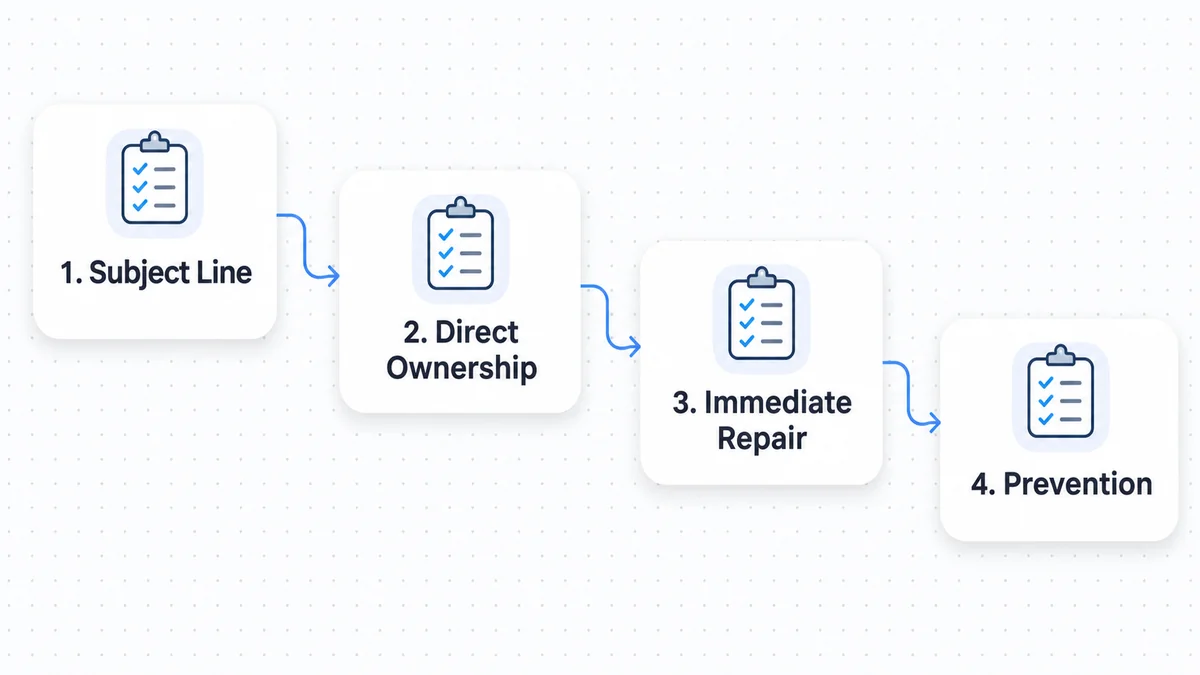
1. Write a direct and informative subject line
A subject line such as "My apologies" or "Quick note" leaves the recipient guessing. They can't tell which project is affected or whether they need to act now. If you're sending an urgent fix or a revised attachment, say so in the subject.
The Purdue Online Writing Lab email etiquette guide recommends subject lines that tell readers what to expect. Include the project name, what the email concerns, and any action the reader needs to take.
Compare these subject line pairs:
- Vague: So sorry!
- Clear: Correction: Revised Schedule for Product Launch
- Vague: Mistake on my part
- Clear: Update and Apology: Corrected Billing Invoice #4821
- Vague: Following up on meeting
- Clear: Action Required: Updated Deck with Corrected Budget Figures
If you're replying in an existing thread, keep the original subject with a clear prefix. That helps the reader follow the discussion without losing the earlier messages.
2. Acknowledge the error and state ownership in the opening
Start with a professional greeting, then name the error in the first two sentences. Phrases such as "mistakes were made" or "a misunderstanding occurred" hide who did what. Say what you did or what your team failed to deliver.
Don't make the apology conditional on the reader's reaction. "If anyone was confused" or "if this caused any trouble" can make a real problem sound minor or imaginary.
Compare these opening statements:
- Evasive: I am sorry if there was any confusion regarding the delivery date.
- Accountable: I apologize for missing our agreed project deadline this morning.
- Evasive: An error was introduced during the document formatting phase.
- Accountable: I made a mistake when formatting the final data tables.
A direct opening leaves no doubt about what went wrong or whether you accept responsibility.
3. Provide concise context without making excuses
A short explanation helps the reader understand what went wrong. Keep it focused on the failure in the process. Blaming colleagues, a busy schedule, or technical glitches makes it sound as though you're trying to excuse the result.
Harvard Business Review describes how accepting blame openly helps organizational apologies succeed. Keep your explanation to one or two factual sentences instead of building a case for why the mistake wasn't your fault.
Consider the difference between an excuse and context:
- Excuse: I missed the deadline because our team has been overwhelmed with requests and my internet connection dropped yesterday evening.
- Objective context: I misjudged the time needed to verify the external citations, which delayed the final review.
The second explanation identifies what caused the delay and keeps responsibility with the writer.
4. Present an immediate offer of repair
An apology won't solve a problem that's still holding up someone's work. Tell the reader exactly what you've done to correct it, or what you're doing now. That gives them something they can act on.
If you sent incorrect data, send the verified dataset. If you missed a meeting, provide a written summary of the decisions or suggest specific times to reschedule. For a delayed shipment or deliverable, give the updated tracking details or delivery timeline.
Be specific about the repair:
- Vague: I will fix this as soon as possible.
- Concrete: I have audited the spreadsheet, corrected the three miscalculated formulas in column D, and attached the revised workbook to this email.
5. Explain how you will prevent the mistake from happening again
Fixing today's problem is only part of rebuilding trust. Your colleague or client also wants to know whether the same issue will interrupt their work next week. Briefly explain what you're changing in your workflow to prevent it.
Choose a safeguard the reader can understand and verify:
- Weak promise: I will be much more careful in the future.
- Practical safeguard: I have created a pre-flight checklist for all client deliverables and scheduled our internal reviews 24 hours prior to final submission.
A change to your process gives the reader a reason to trust the next delivery. A promise to pay more attention gives them much less to go on.
6. Close with forward-looking appreciation
Close by thanking the recipient for their patience, understanding, or for catching the error. You don't need to ask for forgiveness again.
The UNC Chapel Hill Writing Center email guidelines recommend choosing a tone that suits the audience and ending with a polite sign-off. A calm closing helps you both return to the work without prolonging the awkwardness.
For more on closing business messages, see our guide to writing a professional email.
Taking responsibility vs. over-apologizing
Failing to apologize damages trust, but too many apologies can cause problems too. Watch for repeated "I am so sorry" statements, remarks that put yourself down, and apologies for routine events or circumstances outside your control.
Over-apologizing has three consequences:
- It can weaken your credibility. Repeatedly putting yourself down makes colleagues and clients question your competence and judgment.
- It asks the recipient to comfort you. They may feel pushed to reply with "It's okay, don't worry about it!" when they need to focus on the fix.
- It makes serious apologies carry less weight. If you apologize profusely for a calendar invite sent five minutes late, it becomes harder to convey regret for a major project mistake.
For a minor delay or a routine adjustment, try thanking the reader for their flexibility. You can acknowledge their patience without making a small issue sound worse than it is.
For example, "Thank you for your patience while I gathered these numbers" acknowledges the other person's time more directly than "Sorry for the delay!" It keeps the attention on what they did rather than on how you feel.

Phrases to use and phrases to avoid
A few words can make an apology sound defensive even when you mean it sincerely. Check your draft against these common phrases:
| Common weak phrase | Why it fails | Accountable alternative |
|---|---|---|
| I am sorry if anyone was offended. | Makes the recipient's reaction the problem rather than your action. | I apologize for my insensitive remark during yesterday's planning meeting. |
| Mistakes were made on our end. | Passive voice conceals agency and dodges personal responsibility. | I made an error when preparing the distribution list. |
| I am sorry for any inconvenience this may have caused. | Cliche and conditional; minimizes real disruptions. | I apologize for the disruption this delay caused your team. |
| Obviously this was not my fault, but... | Shifts blame immediately while offering a fake apology. | While vendor delays contributed, I should have flagged the schedule risk sooner. |
| I am so terribly sorry, I feel awful about this. | Centers your personal feelings rather than the recipient's needs. | I apologize for this oversight and have outlined our corrective plan below. |
| I will try to do better next time. | Vague and non-committal; lacks concrete safeguards. | I have updated our quality checklist to catch similar discrepancies in advance. |
Look for passive verbs that hide responsibility, conditional wording that questions the impact, and emotional language that asks for reassurance. Keep the account of what happened direct and factual.
Before and After edit examples
These edits show how to take responsibility without making excuses or asking the recipient to comfort you.
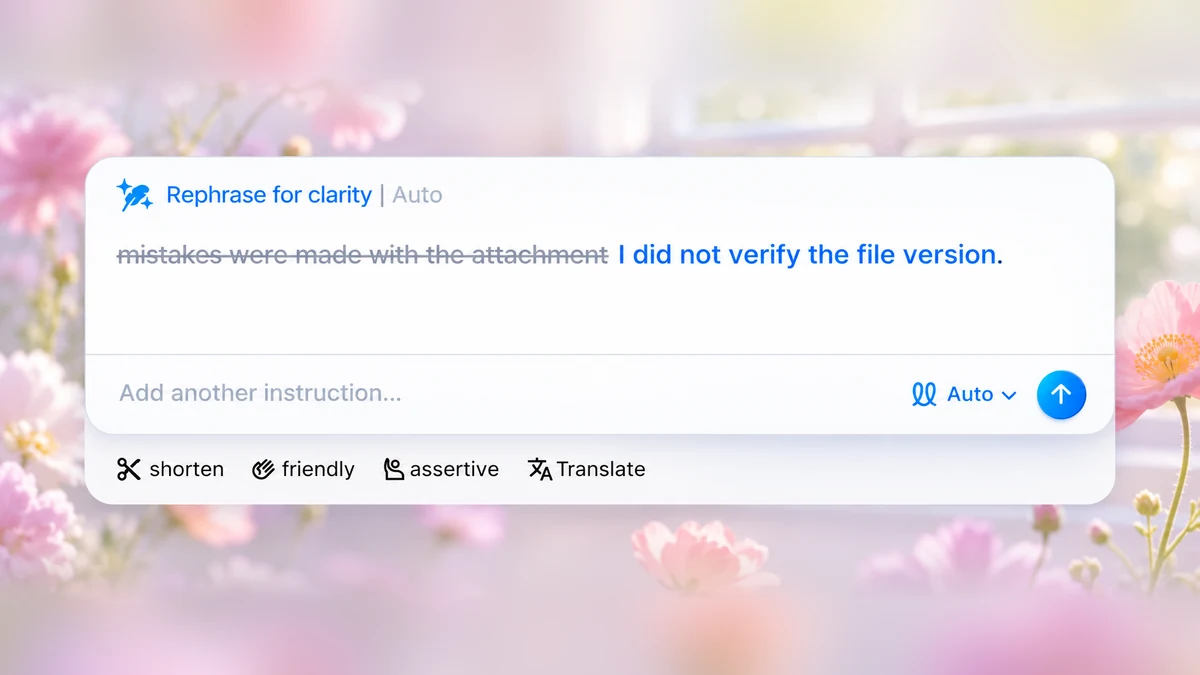
Edit 1: Shifting from defensive hedging to clear accountability
An account manager sent an outdated pricing sheet in a morning email to an external client who requested the current Q4 pricing schedule and active account rate table. The client flagged the discrepancy. The sender had failed to verify the file version against the live sales directory before attaching it and relied on legacy templates stored in a local workspace. To prevent this error from recurring, the sender already archived all legacy pricing templates from the local workspace and planned to cross-reference the live sales directory before distributing materials. The initial draft blames colleagues and computer lag instead of taking ownership.
Here is the unedited draft:
Before: Hi Marcus, I am writing to say I am sorry about the pricing sheet in my morning email. You asked for the current Q4 pricing schedule and active account rate table, but unfortunately our marketing department updated the files on the shared server without notifying anyone, and my computer was also lagging during the upload process, so mistakes were made with the attachment. I apologize if this caused any confusion on your end. I have attached what should hopefully be the right file now. Let me know if you need anything else.
Here is the revised version:
After: Hi Marcus, I apologize for sending the outdated pricing sheet in my morning email. I did not verify the file version before attaching it. I have attached the current Q4 pricing schedule, which reflects the active rate table for your account. To prevent this error from recurring, I have archived all legacy pricing templates from my local workspace and will cross-reference the live sales directory before distributing materials. Thank you for bringing this discrepancy to my attention.
Why this edit works: The revised email replaces defensive excuses about shared servers and computer lag with direct ownership of the mistake. Stating that the sender did not verify the file version clarifies the problem immediately. The client receives the correct Q4 pricing schedule and active rate table, along with confirmation that legacy templates have been archived and future files will be checked against the live sales directory.
Edit 2: Shifting from excessive groveling to a calm, professional solution
A team member missed an agreed 10:00 AM deadline for a background research brief that a colleague needed for an afternoon client presentation. The delay happened because the writer underestimated the time required to format the competitor data tables and finalize details this morning. The completed brief has the executive summary and key statistics highlighted on page one for quick reference. Instead of calmly delivering the brief and planning to complete preliminary drafts the day before shared milestones to protect the review window, the first draft spends most of the message groveling.
Here is the unedited draft:
Before: Dear Elena, I am so completely sorry for missing our 10:00 AM deadline with the research brief! You must be furious with me, and I honestly feel terrible about letting you down right before your afternoon presentation. I underestimated the time needed to format the competitor data tables this morning, but that is no excuse and I am just the worst at managing my calendar lately. Please forgive me! The complete brief is attached, with the executive summary and key statistics highlighted on page one for quick reference. Moving forward, I will just finish preliminary drafts the day before our milestones so you have time to review. I really hope I didn't ruin your preparation. Again, I am so sorry!
Here is the revised version:
After: Dear Elena, I apologize for delivering the research brief past our agreed 10:00 AM deadline. I underestimated the time required to format the competitor data tables this morning. The complete research brief is attached, with the executive summary and key statistics highlighted on page one for quick reference during your afternoon presentation. Moving forward, I will complete all preliminary drafts the day before shared milestones to protect your review window. Thank you for your patience while I finalized these details.
Why this edit works: The revised response cuts emotional groveling such as "You must be furious with me" and "Please forgive me," so Elena does not have to spend time reassuring the writer before her presentation. It keeps the factual explanation about the competitor data tables, directs her straight to the highlighted executive summary and key statistics on page one, and commits to finishing drafts the day before future milestones.
Apology email examples for common workplace scenarios
Use these templates as starting points. Replace the names, facts, and deliverables with the details of your situation.
Example 1: Missed project deadline to a manager or team
If you miss a project milestone, your manager needs three things right away: acknowledgment of the delay, a delivery time, and an explanation of how it affects the work that depends on yours.
Subject: Status and Apology: Revised Delivery for User Onboarding Flow
Hi Jennifer,
I apologize for missing our 9:00 AM deadline to deliver the finalized user onboarding wireframes today.
During my final review this morning, I realized that two error states were missing from the mobile account setup sequence. Because submitting an incomplete specification would delay the engineering team later this week, I chose to draft those missing screens before handing off the package.
Here is our updated delivery plan:
- The completed wireframes and interactive prototypes will be uploaded to the team repository by 2:00 PM today.
- I will run a 15-minute walkthrough with the engineering leads at 3:30 PM to answer open questions and prevent handoff delays.
- This schedule adjustment will not alter our planned sprint start on Monday morning.
To ensure future deadlines account for complete state coverage, I have expanded our design acceptance checklist to include edge cases during the initial drafting phase. Thank you for your patience while I complete these specifications.
Best regards,
Alex
If you're waiting for someone else's delayed work, our guide on how to ask for a status update explains how to follow up clearly and tactfully.
Example 2: Service or billing mistake to a customer
Take particular care with customer apologies involving money, contracts, or account access. Explain the fix early and make the financial records easy to check.
Subject: Correction: Resolution for Account Invoice #1094
Dear Mr. Holloway,
I apologize for the billing discrepancy on your November statement for account #1094.
Our team mistakenly charged your account for the premium analytics add-on, which was scheduled for cancellation at the close of your October billing cycle. I failed to verify the cancellation status in our merchant platform prior to generating your monthly statement.
We have taken the following steps to resolve this error:
- A full refund of $150.00 has been credited back to your original payment method. You should see this credit reflected on your banking statement within two to three business days.
- A revised invoice reflecting your standard base subscription of $300.00 is attached to this email for your records.
- I have updated your account profile to prevent automated billing for discontinued modules.
We value your continued partnership with our team. Please let me know if you would like me to review any other line items on your recent statements.
Sincerely,
Rachel Green Client Services Manager
Example 3: Data oversight or communication error to a colleague
A small data omission can lead to larger reporting errors when other departments use the same figures. Send your colleague the correction promptly, explain what needs updating, and keep the tone respectful.
Subject: Update: Corrected Regional Sales Data for Tomorrow's Review
Hi David,
I apologize for sending an incomplete regional sales dataset in my message yesterday afternoon.
When compiling the regional exports, I omitted the final week of Northwest store figures from the aggregate summary table. This resulted in an undercount of total units sold for that territory.
I have updated the shared master sheet with the verified figures. Here is what changed:
- Northwest unit totals increased by 1,420 units.
- The overall quarterly sales variance has been adjusted from -2.1% to +0.8%.
- Slide 4 of your presentation deck has been updated directly with the revised bar chart.
You do not need to recalculate any downstream metrics; all linked charts in the shared folder now reflect the accurate totals. To prevent similar omissions in future summaries, I have automated the weekly query export to pull full date ranges directly.
Thank you for your understanding, and best of luck with tomorrow's presentation.
Best,
Marcus
How to review and polish your apology email before sending
It's easy to miss a typo, an attachment, or a sharp phrase when you're writing under stress. Spend five minutes checking the email before you send it. An apology with another preventable error can weaken the confidence you're trying to restore.
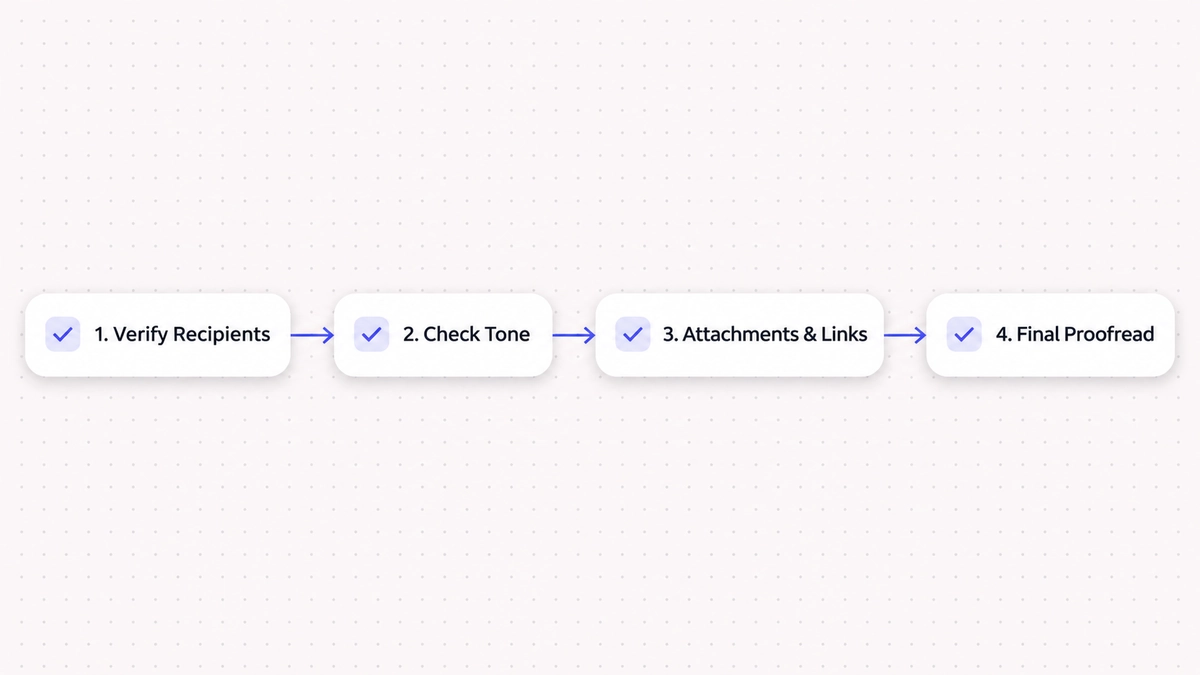
Check these points before sending:
- Verify recipient addresses. Send the apology to the people directly affected. Use "Reply All" only if everyone on the thread needs the update.
- Check how you're feeling. If you're defensive, frustrated, or panicked, step away for ten minutes. Give yourself time to write a factual account.
- Check attachments and links. If you promise a corrected file, make sure you've attached it, named it correctly, and included the updated data.
- Remove hedges. Look for "it appears that," "sort of," "possibly," or "inconvenience caused." Replace them with direct statements about what happened.
- Proofread. Spelling and grammar mistakes can suggest that you still haven't paid enough attention to the details.
Our guide on what is proofreading covers ways to catch subtle errors when you review an important message.
If you use conversational assistants to draft emails, see our advice on writing emails with ChatGPT, and check the tone and any commitments before sending. The Wordfully features include real-time corrections, one-click rewrites and tone changes in Gmail, Google Docs, Slack and most other web apps.
Frequently asked questions about apology emails
When should you send an email versus picking up the phone?
Email works well when you need a written record, corrected attachments, or a detailed explanation of a technical fix. If the mistake caused severe financial harm, damaged a personal relationship, or created an urgent crisis, call or meet face to face first.
Use that conversation to take responsibility and acknowledge the impact. Follow up immediately by email with the actions you agreed on and the repair timeline.
What should you do if the mistake was only partly your fault?
On a shared project, several people or a vendor delay may have contributed to the problem. Take responsibility for the part you controlled without using the email to assign blame to everyone else.
For example: "While external shipping delays affected our delivery window, I failed to alert you when the first transit alert was triggered." This acknowledges the delay while owning the missed warning. Colleagues and clients can see that you're willing to account for your own decisions.
How quickly should you send an apology email after discovering an error?
Send the apology as soon as you have checked the facts and can offer a realistic remedy. A prompt response helps repair trust.
If finding the cause or a fix will take several hours or days, send a brief holding email immediately. Acknowledge the issue, explain that you're investigating, and say when you'll send a full update. Silence while you look for an answer can seem like avoidance.
Is it better to say "I apologize" or "I am sorry"?
Both work in professional emails. "I apologize" sounds more formal and less personal, which suits client messages, legal or financial matters, and updates to executives.
"I am sorry" feels more personal and can suit close colleagues, direct reports, or informal team messages. Either phrase needs a clear statement of responsibility and an offer to fix the problem. That matters more than which opening you choose.
How should you follow up after the apology email is sent?
After you've sent the apology and provided the fix, let the matter rest. Bringing it up again in later meetings or emails makes the other person revisit the inconvenience and can suggest that you still need reassurance.
Follow through on your commitments and check that your new safeguards work. Consistent, reliable work on the next tasks will do more to rebuild trust than another apology.