
How to Say No Politely in an Email

To say no politely in an email, thank the person for asking and give your answer within the first two sentences. Explain briefly why you cannot help. Offer an alternative if you have one you can follow through on; otherwise, a courteous closing is enough. The reader needs to know where things stand so they can plan, and you need time to finish the work you have already agreed to do.
Saying no can feel uncomfortable, especially when you want to work with this person again. You might worry about seeming unhelpful or missing an opportunity. So you add an apology, explain a little more, and soften the answer until it sounds like you might agree. That leaves the other person waiting and puts you at risk of taking on work you cannot finish.
If you are waiting for someone else to reply, our guide on how to ask for a status update covers that side of the exchange. When someone is waiting for your decision, answer promptly and make the decision easy to find.
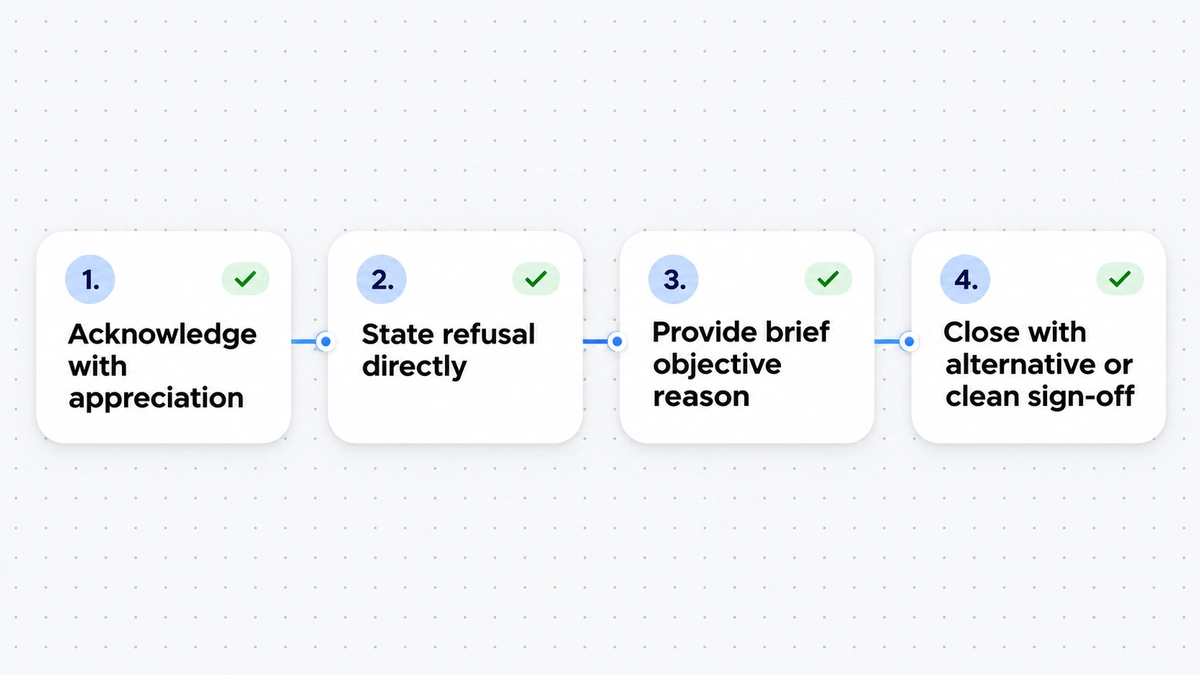
The 4-step framework for saying no in an email
These four steps give you an order to follow when you are unsure how to start. Use words you would say to the person in a calm conversation. Stiff corporate language will not make the refusal more polite.
The five-part structure of a professional email still applies. Keep the greeting and closing, with a clear answer between them.
1. Acknowledge the request with appreciation
Name the request and thank the sender for thinking of you. One sentence is enough: "Thank you for thinking of me for the client onboarding initiative." This acknowledges the invitation without suggesting that you have agreed to help.
2. State your refusal directly
Put your answer within the first two sentences. A long opening can make the reader expect a yes, even when you are building up to a no.
The MIT Communication Lab guide on professional email recommends putting your main point first. "I might have trouble" or "I am not sure if I can" leaves room for the sender to try to persuade you. If you have decided, say so: "Unfortunately, I am unable to take on this project."
3. Provide a brief, objective reason
Explain what prevents you from accepting. Your workload may already be full, another deadline may take priority, or the task may fall outside your team's responsibilities. That context helps the reader understand why you are declining.
Writing about extra assignments, Rebecca Knight in the Harvard Business Review advises keeping the explanation short and focused on existing commitments. "My schedule is currently dedicated to completing our quarterly system audit" gives the reader enough context. You do not need to account for every hour of your day.
4. Close with a realistic alternative or a clean sign-off
Close with any help you can realistically offer. That might mean a later date or a referral to a colleague. Existing documentation may also answer the request. If none of those options works, wish the person well with the project and sign off. Guilt is a poor reason to make another commitment.
| Refusal scenario | Core objective | When to use | Key phrase pattern |
|---|---|---|---|
| Extra project or task | Protect existing deliverables | Bandwidth is fully committed | "I cannot take this on right now because my schedule is focused on..." |
| Unrealistic deadline | Negotiate timeline or scope | Task is feasible, but requested date is not | "I cannot deliver the full report by Tuesday, but I can finish it by Friday." |
| Meeting invitation | Protect focused working hours | Attendance is optional or calendar conflicts | "I have a scheduling conflict at that time and will not be able to attend." |
| Out of scope request | Clarify role responsibilities | Request falls outside your job function | "This falls outside my team's area; I suggest connecting with..." |
Declining extra work from colleagues and managers
With a colleague, you can explain that you do not have time to help. With a manager, you will usually need to discuss which work takes priority. The emails below handle those conversations differently.
Saying no to a peer or colleague
A coworker needs to know whether they can count on your help. Name the project, explain what already fills your schedule, and give a clear answer:
Subject: Re: Support for market research analysis
Hi David,
Thank you for thinking of me for the market research analysis. It sounds like an important initiative for the product launch.
Unfortunately, I cannot take on this work right now. My bandwidth is fully committed to finishing the customer retention audit through the end of the month.
I hope the analysis goes smoothly, and I would be glad to explore collaborating on future projects once my schedule opens up.
Best regards, Alex
Alex gives David a reason and a definite answer. The friendly closing leaves room to work together later without promising to take on the current analysis.

Saying no to your manager: framing trade-offs
When your manager adds a project to a full schedule, ask which existing task should move. A flat refusal rarely helps them decide how to assign the work. List your commitments and their deadlines so your manager can see what accepting the new task would mean:
Subject: Prioritization check: Q4 vendor onboarding
Hi Sarah,
Thank you for looping me in on the vendor onboarding project. I would be glad to help move this forward.
Currently, my schedule is dedicated to finishing the security compliance documentation by Friday and preparing the monthly executive briefing for Tuesday. Taking on the vendor onboarding work this week means one of those milestones would need to shift.
Could you let me know how you would like me to prioritize these? If you prefer that I focus on the vendor onboarding, we can postpone the compliance review to next week.
Best regards, Marcus
Marcus explains which deadlines would be affected and asks Sarah to choose. She can weigh the vendor onboarding against the compliance review instead of assuming all the work will still fit into the week.
Pushing back on an unrealistic deadline
You may have time for the project but still be unable to meet the requested date. Agreeing anyway risks rushed work and errors, along with the stress of trying to finish too much at once. Give the requester something they can consider. There are three ways to adjust the plan:
- Propose an extended timeline with the full original scope.
- Propose a reduced scope delivered by the original deadline, with remaining items completed later.
- Request resource support or priority adjustments to meet the target date.
Proposing an alternative delivery date
If the work needs to arrive as a whole, offer a date you can meet alongside your existing commitments.
Subject: Re: Draft review for annual policy update
Hi Elena,
Thank you for sending over the draft of the annual policy update.
I cannot complete a thorough review by tomorrow afternoon because of previously scheduled client workshops. However, I can review the complete document and return my detailed feedback to you by Thursday at 2 PM.
Please let me know if that updated timeline works for your publication schedule.
Best regards, Jordan
Offering a phased delivery for urgent timelines
If the requester cannot move their deadline, check whether part of the work would be useful sooner. They may be able to use that portion while you finish the rest.
Subject: Re: Financial model projections for investor deck
Hi Thomas,
Thank you for the update on the investor presentation timeline.
I cannot assemble the complete three-year financial forecast by Wednesday morning. To help you prepare for your initial planning meeting, I can send the revenue projections and cost summary by Wednesday at 9 AM, followed by the full balance sheet model on Friday.
Let me know if this phased approach gives you what you need for the preliminary discussion.
Best regards, Rachel
Rachel says exactly what Thomas will receive on Wednesday and what will follow on Friday. He can decide whether those pieces are enough for the preliminary discussion.
Declining a meeting invitation
A meeting takes time away from other work. You can decline when your attendance is optional or you have a scheduling conflict. Sometimes an email update will cover what the organizer needs from you.
The Purdue OWL email etiquette guide advises a respectful, objective tone and prompt replies. Answer early enough for the organizer to change the attendee list or reschedule if they need you there.
When you have a schedule conflict
Say that you have a conflict. You do not need to list your other meetings or explain your personal schedule.
Subject: Re: Cross-team alignment on project workflows
Hi Kevin,
Thank you for the invitation to the workflow alignment session.
I have a conflicting commitment during that hour and will not be able to attend. If there are specific questions regarding the data migration phase, please feel free to send them over email beforehand, and I will share my notes.
I look forward to reviewing the meeting summary after the call.
Best regards, Priya
When your presence is not essential
If you are an optional attendee and the agenda does not need your input, let the organizer know you will skip the meeting. That saves them waiting for you to join.
Subject: Re: Weekly regional marketing sync
Hi Lucas,
Thank you for including me in the weekly regional marketing sync.
Looking through the agenda, the topics focus primarily on physical event logistics, which falls outside my current digital campaign responsibilities. To keep the attendee group focused, I will decline this session.
Please let me know if any digital campaign dependencies arise, and I will be happy to assist.
Best regards, Daniel
When to offer an alternative and when a clear refusal is enough
An alternative can help a colleague solve their problem, but it also creates an expectation. Before offering one, check whether you can keep the promise. You can be polite even when you have nothing else to offer.
The advice in our guide to writing a friendly email applies here, too: let the wording carry the warmth while keeping your answer clear.
When to offer an alternative
Before suggesting another plan, check these three things:
- You genuinely want to assist with the project or support the requester.
- The alternative you propose is feasible within your real schedule.
- You have the authority or permission to suggest that alternative.
Choose an option that fits what you can offer:
- Deferring the start date: "I cannot review this proposal this week, but I can look at it next Tuesday if that timing works."
- Referring a capable peer: "I do not have bandwidth for this design task, but Chris from our team has expertise in this area and may have availability."
- Providing existing assets: "I cannot lead the training session this month, but you are welcome to use our slide deck and recording from last quarter."
When a clear refusal is enough
In these situations, a direct refusal lets the person look elsewhere without waiting for help you cannot provide:
- Unsolicited sales pitches or vendor outreach: A simple "Thank you for reaching out, but we are not interested in this service" is sufficient.
- Persistent out-of-scope requests: If someone repeatedly asks you to handle tasks belonging to another department, redirecting them once is helpful, but repeated refusals should be firm and direct.
- Complete lack of capacity: If your calendar is overloaded for the foreseeable future, offering to help "sometime soon" creates a false expectation that leads to disappointment later.
- Invitations to non-essential social or optional committee events: A polite sentence expressing that you are unable to join is complete on its own.
Common mistakes when writing a refusal email
If you feel uneasy about declining, check whether that discomfort has made your draft longer or less clear. These are common places to cut back.
1. Over-apologizing
"I am so terribly sorry to let you down" makes a full schedule sound like something you need to defend. Repeated apologies can overwhelm the answer. Thank the person for asking or state that you are unavailable; you do not need a long apology for managing your workload.
2. Over-explaining personal circumstances
Details about doctor visits, family obligations, or personal stress can invite the reader to judge whether your reason is good enough. They also make the answer harder to find. A brief explanation about your workload or a scheduling conflict is enough.
3. Using weak qualifiers and tentative language
"I might be able to help later," "I will see what I can do," and "It looks a bit tough right now" all leave the decision open. The reader may think you are still trying to fit the task in. If you have already decided to decline, remove that uncertainty.
4. Delaying your response
It is tempting to leave the email in your inbox until you find a comfortable way to say no. Meanwhile, the other person is waiting as their deadline gets closer. A polite decline within one business day is more useful than an apology three days later. Your answer gives the sender time to find someone else.
5. Writing in the passive voice to avoid ownership
"It has been determined that the project cannot be accepted" sounds like an official notice. It also hides who made the decision, which can make a personal reply feel distant.
The Digital.gov guide to clear writing recommends active voice to make responsibilities clear and cut filler. "I cannot take on this project" tells the reader who is declining and what the answer is.
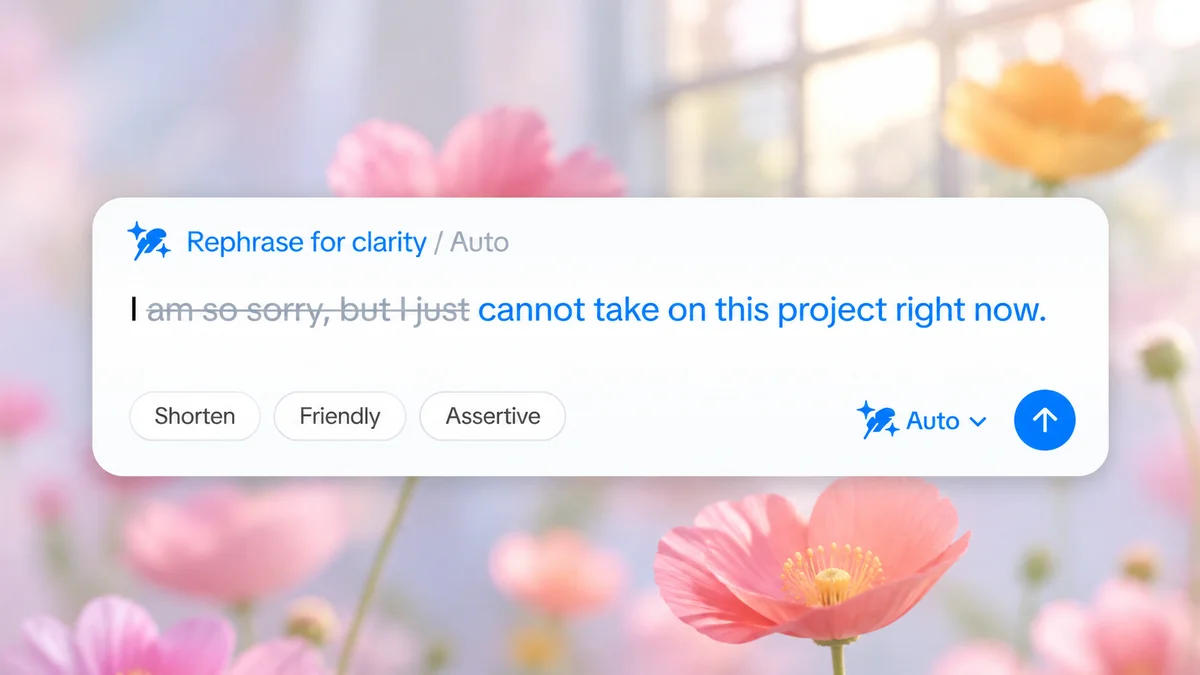
With an AI proofreader, Rephrase rewrites a sentence, tone commands can make a message friendlier, firmer or shorter, and suggestions appear in Gmail, Slack and other web apps. Read the draft yourself as well, checking that the answer is clear and the tone fits the person you are writing to.
Worked Before and After editing examples
These four Before and After examples illustrate how to transform hesitant, overly apologetic, or blunt drafts into clear and courteous professional refusals. Each revision preserves the factual situation while removing unnecessary filler.
When an initial draft sounds overly blunt or defensively apologetic, learning how to rewrite a sentence helps you find a balanced, neutral tone.
Example 1: Removing excessive apologies from an extra-work refusal
Before: I am so sorry, but I just cannot take on this project right now because I have way too much work on my plate and things are totally overwhelming.
After: Thank you for thinking of me for this project. Because my schedule is fully committed, I cannot take this on right now.
Why this edit works: The Before version relies on emotional words ("so sorry", "just", "way too much", "totally overwhelming") that sound flustered. The After version replaces the apology with professional gratitude, points to a fully committed schedule objectively, and states the refusal cleanly without adding any new facts.
Example 2: Turning a vague deadline hedge into a clear refusal
Before: I will try my best to finish reviewing the contract draft by Tuesday, but it might be really difficult because of other client meetings.
After: I cannot finish reviewing the contract draft by Tuesday because of other client meetings.
Why this edit works: "I will try my best" leaves the recipient unsure whether the review will arrive on Tuesday or not. The After version eliminates the uncertainty, declines the Tuesday deadline directly, and keeps the reference to other client meetings without inventing a new delivery date.
Example 3: Declining an optional committee invitation cleanly
Before: I would love to be on the office social planning committee, but honestly I am just so busy with my everyday tasks that I don't think I can make it work this quarter.
After: Thank you for the invitation to join the office social planning committee. Due to my current workload, I am unable to participate this quarter.
Why this edit works: The revised version cuts conversational filler ("honestly", "just so busy", "I don't think") and delivers an appreciative, direct refusal. It keeps the same decision while elevating the professional tone.
Example 4: Refusing an out-of-scope technical request
Before: Sorry, but building custom database reporting dashboards really isn't part of my job description, so you should probably ask someone over in business intelligence instead.
After: Thank you for reaching out. Building custom database reporting dashboards falls outside my role. I recommend contacting the business intelligence team.
Why this edit works: The Before draft sounds dismissive and irritated ("isn't part of my job description", "probably ask someone"). The After version describes the speaker's role neutrally and provides a constructive referral without defensive language.
Frequently asked questions about saying no in an email
How do I say no politely without using the word "no"?
Use a phrase such as "I am unable to take this on," "My schedule is fully committed," or "I cannot accommodate this request at this time." Each gives a clear answer without using the word "no." Choose the wording that sounds natural for your relationship with the reader.
Is it unprofessional to decline a request without offering a reason?
A brief reason usually helps at work. Mention conflicting deadlines or a full schedule so the person understands what prevents you from accepting. You do not owe a detailed account of your commitments. Saying that you have no capacity for new work is enough.
What should I do if someone pushes back after I say no?
Use the broken-record technique: calmly repeat the same answer. Acknowledge the person's situation, then explain that your constraint still applies: "I understand this is an important deadline for your team, but as mentioned, my schedule is fully committed to our existing launch milestones, so I cannot take this on." Adding a new excuse each time gives the person another point to negotiate.
How do I say no to an urgent request that arrives late in the day?
Reply promptly if you cannot finish the work that evening. Give the sender a clear answer and, if possible, a time you can help: "Thank you for reaching out. I have signed off for the day and will not be able to review this tonight. I can look at this tomorrow morning at 9 AM if that timeline works for you." Only offer the morning review if you can fit it into your schedule.
Does declining a project damage professional relationships?
A professional refusal lets colleagues and managers plan around your available time. Promising work and then failing to deliver causes problems for them. Be honest about what you can do and answer while there is still time to find another solution.

Summary checklist for your next refusal email
Read your reply once before sending it and check:
- Did you acknowledge the request and thank the sender within the first sentence?
- Is your refusal stated clearly in the first two sentences without vague hedging?
- Is your reason concise, professional, and focused on capacity rather than personal excuses?
- Did you eliminate unnecessary apologies and defensive justifications?
- If you offered an alternative, is it realistic and within your control?
- If you have no alternative, did you provide a clean, courteous closing without false promises?
- Did you reply promptly so the sender can plan their next steps?