
How to Rewrite a Sentence Without Changing Its Meaning

To rewrite a sentence without changing its meaning, first work out what it says and which details have to stay. Then change the structure: turn a heavy noun into a verb, split tangled clauses, move the main point forward, or cut filler. Reaching for a thesaurus won't solve a sentence whose words are in the wrong order.
You might be revising a stiff draft, a long technical explanation, or a message that sounds too formal for the person receiving it. The aim is to make it easier to read while keeping the facts, conditions, numbers, and level of certainty. A smoother sentence still needs to say what you meant.
Compare the result with your draft before you keep it. Small changes can slip past when you're concentrating on how the sentence sounds. If you often edit other people's work or tool-generated drafts, this checklist to check an AI rewrite gives you a way to catch those changes.
Five techniques to rewrite a sentence at a glance
Find the problem you're trying to fix, then check what the edit needs to preserve.
| Problem in draft | Rewriting technique | Primary mechanism | What to protect |
|---|---|---|---|
| Stiff, bureaucratic tone | Swap nominalizations | Turn abstract nouns into direct action verbs | Technical definitions and legal terms |
| Overloaded clauses | Split long sentences | Divide compound ideas into standalone sentences | Logical connectors between ideas |
| Buried key points | Reorder clauses | Move the main result or action to the beginning | Modifiers and qualifying conditions |
| Unclear responsibility | Adjust voice | Shift between active and passive verb forms | The actor and the direct object |
| Wordy padding | Remove deadwood | Delete empty introductory phrases and filler words | Nuanced politeness and true context |
What must remain unchanged during a rewrite
The StudySmarter writing resource on reformulating ideas describes reformulation as expressing the same thought in different words. General paraphrasing may condense secondary information. When you're rewriting a sentence, protect these four elements:
- Quantitative facts and dates: Keep deadlines, percentages, financial amounts, and proper names exactly as they are. Changing "by Friday at noon" to "by the end of the week" alters the agreement.
- Conditions and contingencies: Words like "if," "unless," "provided that," and "except" set rules. Dropping a prerequisite or softening an exception misleads the reader.
- Levels of certainty: Modal verbs tell readers whether an action is possible, required, or certain. "Might," "could," and "may" express possibility; "must" and "will" express a requirement or certainty. Replacing "we might postpone" with "we will postpone" introduces a false promise.
- Core relationships: Keep track of who acted and who received the result, even if you change the grammatical subject.
A word that looks similar to another may carry a different meaning. Check commonly confused words before making a substitution that could change the sentence's legal or grammatical meaning.
Technique 1: Swap nominalizations for action verbs
A nominalization is a noun formed from a verb or an adjective, often ending in suffixes such as -tion, -ment, -ance, or -ity. Examples include "investigation" from "investigate," "decision" from "decide," and "utilization" from "utilize."
Wikipedia's reference on nominalization and sentence density notes that texts with many nominalized words can be dense, writing advice warns against overuse, and an active verb is usually the more direct choice.
Look for a noun paired with a verb such as "make," "conduct," "perform," or "reach." The noun often holds the action, while the verb adds little. Try turning that noun back into the main verb.
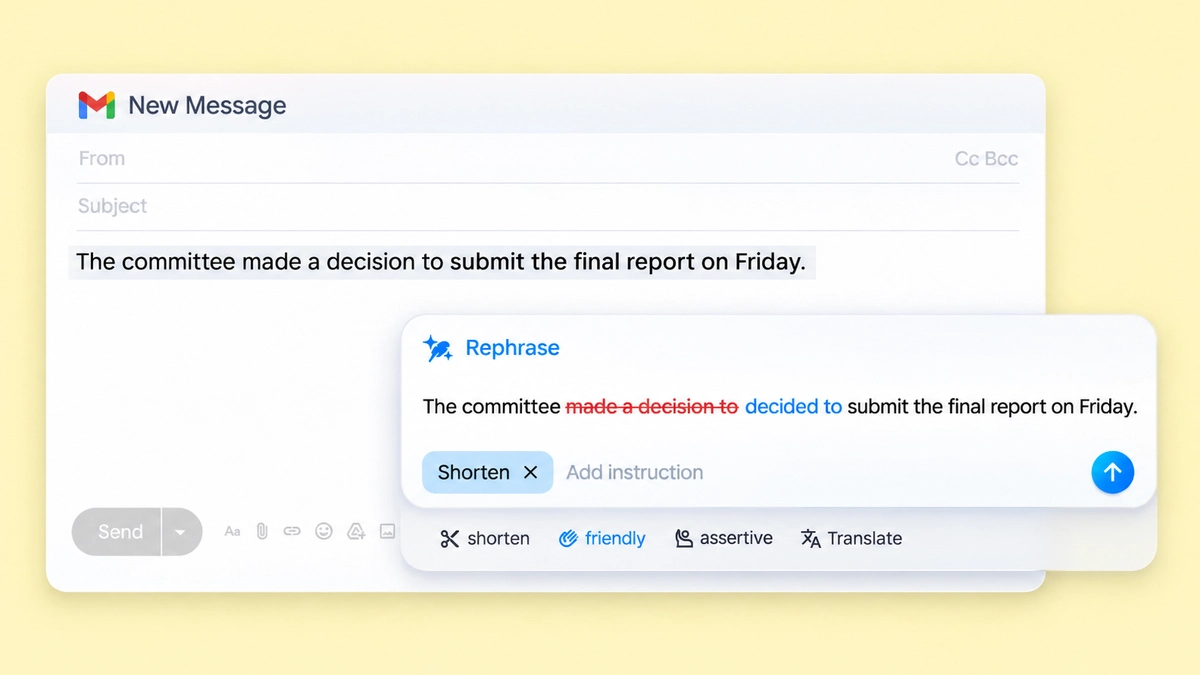
Before: The committee made a decision to submit the final report on Friday.
After: The committee decided to submit the final report on Friday.
"Decided to submit" replaces "made a decision to submit" and cuts two unnecessary words. The committee still makes the decision about submitting the final report on Friday.
The same approach works when a workplace update contains more than one buried action:
Before: The engineering team conducted an investigation into the server outage and reached an agreement on three system modifications.
After: The engineering team investigated the server outage and agreed on three system modifications.
Here, "conducted an investigation into" becomes "investigated," and "reached an agreement on" becomes "agreed on." The engineering team still investigated the outage and agreed on three modifications.
Technique 2: Split compound sentences and stacked clauses
A sentence can become hard to follow when it carries two or three separate thoughts. Clauses joined by "and," "which," "while," and "because" pile up, and the reader has to remember each one before reaching the period.
The Digital.gov guidelines on clear and short sentences recommend one idea per sentence. Long sentences with several dependent clauses can confuse readers; separating the ideas makes them easier to process.
The W3C Web Accessibility Initiative reading level guidance also explains that short sentences and familiar words reduce the effort of decoding text. Readers can spend more attention on what the text means.
Separate clauses that can stand on their own, then check how they connect. You may need a transition word to keep the relationship clear.
Before: Although the software update passed automated tests yesterday afternoon, the deployment was delayed until Thursday morning because the database migration script required manual verification by the infrastructure team.
After: The software update passed automated tests yesterday afternoon. However, the deployment was delayed until Thursday morning because the infrastructure team needed to verify the database migration script manually.
The first sentence gives the test result. "However" introduces the delay in the second, which also explains why it happened. The timing stays exact: testing happened yesterday afternoon, and deployment moved to Thursday morning. The infrastructure team still has to verify the database migration script.
For instructions, a sentence break can separate the first action from what to do if it fails:
Before: Customers who experience login failures after the migration should reset their passwords using the portal link, and if the issue persists after two attempts, they ought to notify technical support directly.
After: Customers who experience login failures after the migration should reset their passwords using the portal link. If the issue persists after two attempts, they should notify technical support directly.
The customer can read the password-reset instruction before considering the next step. Support is still the fallback after two attempts, so the split preserves the condition.
Technique 3: Reorder clauses to shift focus
The beginning and end of an English sentence carry the most emphasis. A main point buried in the middle, or delayed by a long introduction, takes more effort to find.
Decide what the reader needs to see first. In a work message, that will often be the result or request. Sometimes a condition belongs first so the reader sees who qualifies before acting. Moving a clause changes the emphasis and pace while keeping the facts.
Putting the deliverable early in a workplace request helps the reader respond promptly. The advice on how to ask for a status update follows the same approach: bring the question forward so the reader doesn't have to search for it.
Before: Due to unexpected road closures along the primary transit corridor, the regional warehouse will receive the shipment two hours late.
After: The regional warehouse will receive the shipment two hours late due to unexpected road closures along the primary transit corridor.
The warehouse team gets the news first: the shipment will arrive two hours late. The reason follows. Nothing about the road closures, the transit corridor, or the length of the delay has changed.
A qualification can also deserve the opening position:
Before: You can request an expedited review from the department lead if your project budget exceeds fifty thousand dollars.
After: If your project budget exceeds fifty thousand dollars, you can request an expedited review from the department lead.
Readers see the budget requirement before the action they can take. The threshold is still fifty thousand dollars, the request still goes to the department lead, and asking for a review remains optional.
Technique 4: Adjust active and passive voice for clarity
In active voice, the grammatical subject performs the action. In passive voice, the subject receives it. Passive voice is grammatically correct, but it can hide responsibility and add awkward auxiliary verbs.
The Digital.gov plain language principles for short and simple writing recommend active voice and base verbs to cut extra words and make sentences clearer.
Active voice usually makes business and explanatory writing more direct. Keep passive voice when the actor is unknown, confidential, or less important than the result. The choice depends on what the reader needs to know.
Before: The client onboarding presentation was prepared by Marcus and delivered to the executive board on Tuesday.
After: Marcus prepared the client onboarding presentation and delivered it to the executive board on Tuesday.
Marcus becomes the subject of both verbs, so readers can follow who prepared and delivered the presentation. The client onboarding topic, executive board, and Tuesday delivery date stay the same.
Passive voice can put the event first when the actor matters less:
Before: Security analysts detected an unauthorized access attempt on the staging environment at midnight.
After: An unauthorized access attempt was detected on the staging environment at midnight.
This notice puts the unauthorized access attempt first and keeps the staging environment and midnight timing. It drops the security analysts. That omission suits an alert focused on the event, but notice what the edit removes: if you need to preserve who detected the attempt, keep that detail.
Technique 5: Cut filler phrases and deadwood
Filler makes readers wait for the point. Look for phrases that take up space without adding information.
"It is important to note that," "for all intents and purposes," and "in the event that" are common examples. You can usually delete them or replace them with a single word.
The Digital.gov style guidelines on word choice recommend checking prepositions and clusters of nouns. Phrases built around "of," "to," or "on" can often be expressed more directly.
AI drafts and collaborative documents can collect formal transitions that repeat each other without making the meaning clearer. The guide to make AI text sound human explains how to cut that padding so readers can get to the thought behind it.
Before: It should be noted that in order to complete the review process by Friday, team members must verify their project timesheets.
After: To complete the review process by Friday, team members must verify their project timesheets.
"It should be noted that" adds no factual information, so it goes. "In order to" becomes "To." Team members still have to verify their project timesheets to complete the review by Friday.
Corporate phrasing can bury a simple opinion in the same way:
Before: At this point in time, we are of the opinion that the proposed schedule remains viable for all participating vendors.
After: We believe the proposed schedule remains viable for all participating vendors.
"We believe" does the work of the long opening phrase. The sentence still gives the same assessment of the proposed schedule for all participating vendors.
A step-by-step workflow to rewrite any sentence
Use these four steps when you're unsure where to start with an awkward sentence.
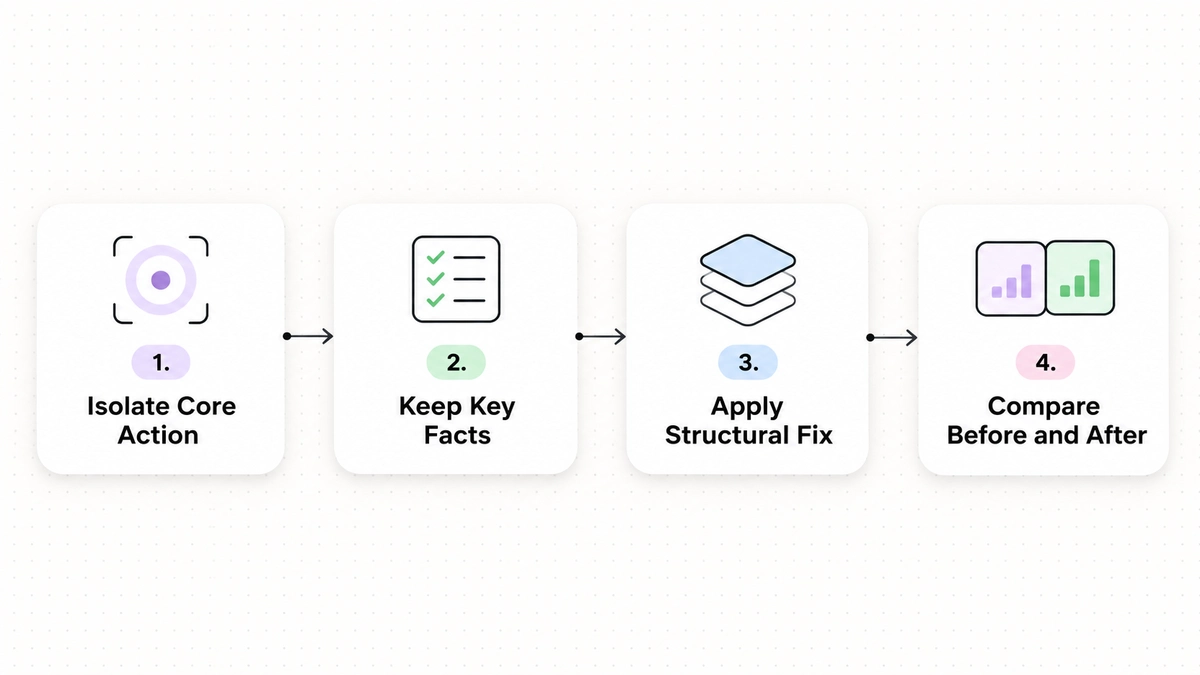
Step 1: Isolate the core actor and action
Ask two questions: Who or what is doing something, and what are they doing?
You may find the actor in a prepositional phrase and the action inside a noun. Work out who does what before changing the wording.
Step 2: Extract non-negotiable details
Mark the dates, quantities, names, restrictions, and conditional words. Keep them visible while you edit so you can check each against the finished sentence.
Step 3: Select the appropriate structural fix
Choose the edit that addresses the problem you found:
- If several "and" or "which" clauses make the sentence hard to follow, split it into two sentences.
- If you see "conducted," "provided," or "made," check whether a nearby noun would work better as a verb.
- If three lines of caveats bury the main result, move that result forward while keeping its conditions clear.
- If passive voice serves no useful purpose, make the actor the subject.
- If the sentence opens with filler such as "It is worth mentioning," cut that opening.
Wordfully's rephrasing and tone features let you try different sentence structures while writing in your browser. You can make a message firmer, friendlier, or shorter, and choose an AI model or use Auto mode. Compare each suggestion with what you intended before accepting it.
Step 4: Compare Before and After side by side
Before sending or publishing, put the draft and revision side by side. Run these three checks:
- Did any numbers, dates, or names shift?
- Are the conditions and probability levels identical?
- Does the new sentence read more smoothly without introducing informal slang or unintended formality?
Common mistakes when rewriting a sentence
These four mistakes are easy to miss when the revised sentence sounds smoother than the draft.
1. Swapping synonyms with different connotations
A thesaurus can suggest words that look interchangeable but mean different things in practice. Replacing "mandatory" with "recommended" turns a requirement into a suggestion. Changing "urgent" to "immediate" shifts the meaning from priority to timing. Keep a word when it has the exact technical or operational meaning you need.
2. Misplacing modifiers during clause reordering
After moving a phrase, check which noun it describes. In "Covered in dust, the manager inspected the archives," the manager is dusty. Changing it to "The manager inspected the archives covered in dust" can make the description refer to the documents. The words may be nearly identical while the picture changes.
3. Dropping qualifying conditions when splitting sentences
Splitting a sentence can detach a condition from the action it limits. If a fee applies only after thirty days, the new sentences must still make that timing clear. Read the part about the fee on its own and check that it doesn't sound as though it always applies.
4. Over-trimming necessary context
Courtesy isn't automatically filler. Cutting every polite phrase from a work email can turn a routine question into something abrupt or demanding. Keep wording that shows respect or sets reasonable expectations, even if it makes the sentence a little longer.

Frequently asked questions about sentence rewriting
What is the difference between rewriting and paraphrasing?
A sentence rewrite changes structure and word choice to improve clarity, flow, or length while keeping the original facts and conditions. Paraphrasing can cover more ground: it may condense several sentences or summarize a paragraph. Decide which job you're doing before cutting secondary details.
Does changing passive voice to active voice always preserve meaning?
Yes, if you know who performed the action and name them accurately. "The invoice was reviewed by Elena" can become "Elena reviewed the invoice" without losing meaning. If you don't know the actor, don't supply one just to use active voice. "The team reviewed the invoice" adds information the original didn't give.
How do I know if a rewritten sentence is too short?
It's too short if you've lost a qualifier, date, or condition, or made the tone blunt and discourteous. The reader shouldn't have to guess why a decision was made or what they need to do before taking an action. Restore the words that answer those questions.
Can rewriting a sentence change its tone without altering its facts?
Yes. Sentence length, voice, and vocabulary affect how a message sounds even when the facts stay the same. Short active sentences can sound confident and urgent. Longer sentences with introductory clauses can sound more deliberate and consultative. Choose the tone that fits the reader and situation.
What is the fastest way to check that a rewrite kept its original meaning?
Read the revision and put its factual claims into your own words. Compare those claims with the draft. Check who is involved, what happens, and whether every deadline and exception still applies. If something is missing or changed, restore it before keeping the rewrite.