
How to Identify and Fix a Comma Splice

A comma splice happens when you join two independent clauses with only a comma. Each clause has a subject and a finite verb and expresses a complete thought, so it could stand alone as a sentence. Putting a comma between them leaves the reader without a clear sentence boundary.
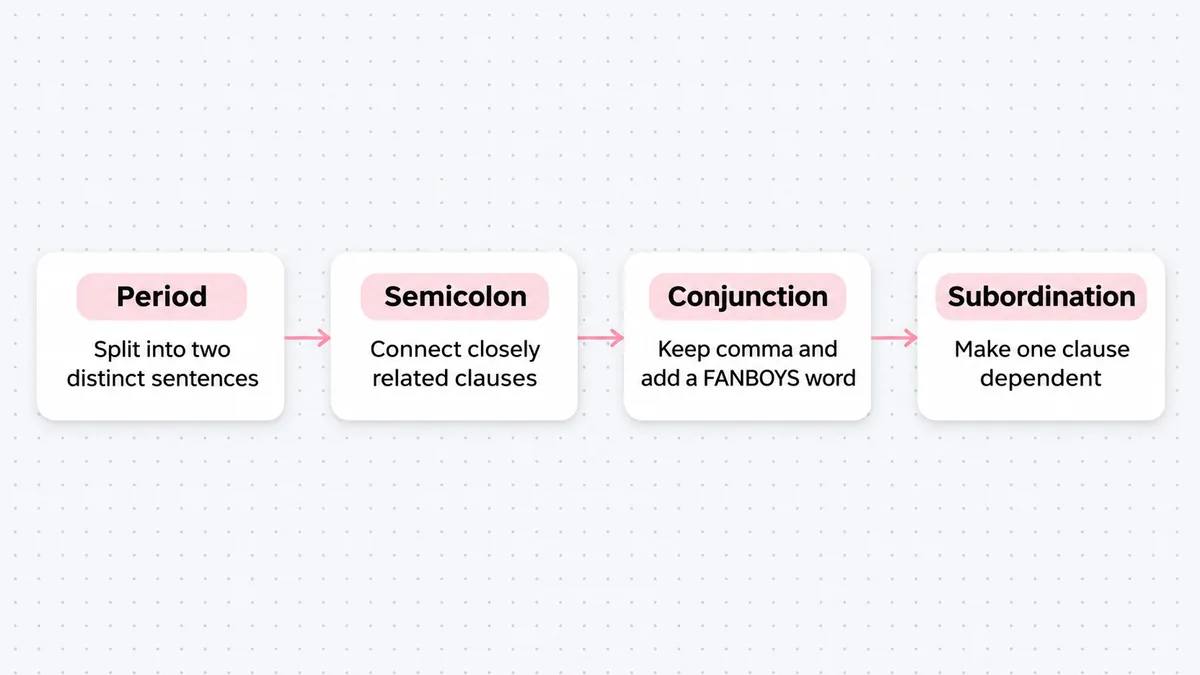
You have four ways to fix it: replace the comma with a period or semicolon, add a coordinating conjunction after it, or make one clause dependent on the other. You usually don't need to rewrite the whole paragraph. The choice comes down to how the thoughts relate and how you want the sentence to sound.
What is a comma splice?
A comma marks a brief pause and separates parts of a sentence, including introductory phrases, nonessential modifiers, and items in a list. But a comma alone can't separate two complete sentences. That's the distinction to check when a sentence looks fine at first glance but feels awkward to read.
The Purdue OWL proofreading guide treats a comma between two independent clauses as an error to correct. The trouble is the punctuation used to join them.
It's easy to see how this happens. When you speak, you can move between related statements with a brief pause, and your voice helps the listener follow. On the page, punctuation has to do that work. A reader who expects a modifier or continuation after a comma may need to go back when a new independent clause starts instead.
How to identify a comma splice: the two-clause test
If you're unsure about a comma between two clauses, read each side separately. Does each part work as a sentence on its own? This two-clause test helps you check the grammar instead of guessing from where you'd pause while speaking.
As the Purdue OWL punctuation overview explains, an independent clause has a subject and verb and can stand alone as a sentence. Removing the rest of the sentence shouldn't leave it feeling unfinished.
Use these three steps:
- Locate the comma that separates the two clauses.
- Read the words before the comma in isolation. Ask yourself: Does this part contain a subject and a verb? Does it express a complete thought? Could it end with a period?
- Read the words after the comma in isolation. Ask the same questions: Does this part have its own subject and verb? Does it express a complete thought that stands alone?
If both sides pass the test and there's no coordinating conjunction between them, the comma creates a splice.
Consider this sample sentence:
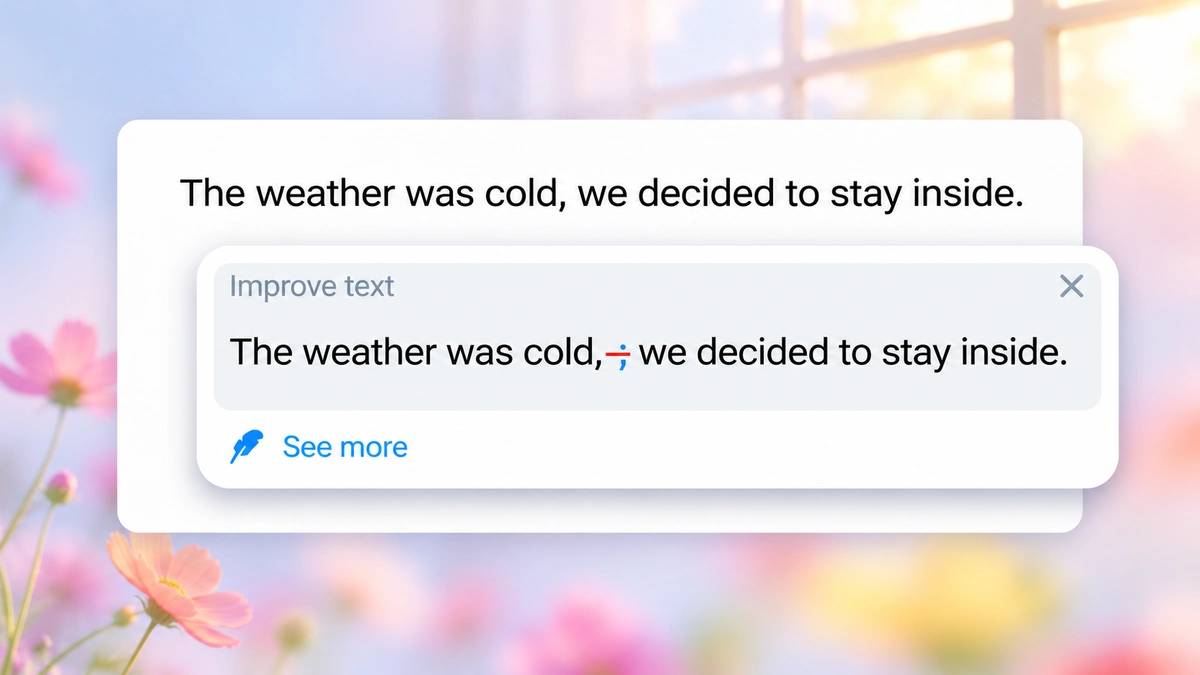
The weather was cold, we decided to stay inside.
Now apply the two-clause test:
Clause 1: "The weather was cold." This clause contains the subject "weather" and the verb "was." It expresses a complete thought and functions as a full sentence.
Clause 2: "We decided to stay inside." This clause contains the subject "we" and the verb "decided." It also expresses a complete thought and functions as a full sentence.
Because both halves are independent clauses, linking them with only a comma creates a comma splice.
Distinguishing comma splices from compound predicates
Don't confuse a comma splice with a compound predicate. In a compound predicate, one subject performs two actions joined by a conjunction. The second part doesn't have its own subject, so it can't stand alone as an independent clause.
Look at these two examples:
Sentence A: The auditor reviewed the accounts, she flagged three discrepancies.
Sentence B: The auditor reviewed the accounts and flagged three discrepancies.
In Sentence A, "she flagged three discrepancies" has a subject, "she," and a verb, "flagged." It can stand alone. Joining it to the first clause with only a comma creates a splice.
In Sentence B, "flagged three discrepancies" shares the subject "The auditor" with the first verb. It isn't an independent clause, so there's no comma splice. A simple compound predicate doesn't normally need a comma before the conjunction unless clarity requires it.
Four methods to fix a comma splice
Each of the four fixes changes the pace or emphasis a little. Choose the one that makes the relationship between your ideas easiest to follow.
Method 1: Separate the clauses with a period
Replace the comma with a period and capitalize the next word. This gives you two separate sentences.
Before: The proposal deadline passed at noon, the review panel began evaluating submissions immediately.
After: The proposal deadline passed at noon. The review panel began evaluating submissions immediately.
The period after "noon" gives the deadline its own sentence. Capitalizing "the" starts the next one, which tells the reader what the review panel did immediately afterward.
When to use a period:
- When both independent clauses are long, detailed, or complex.
- When you want to emphasize both thoughts equally as distinct statements.
- When you want to create a crisp, direct, and authoritative tone.
A period gives the reader a full stop before the next idea. That can help when either clause takes some effort to follow. Read the surrounding sentences too: a paragraph full of short stops can sound choppy, even when each sentence is clear.
Method 2: Link the clauses with a semicolon
A semicolon works when both clauses can stand alone but belong together in meaning. It keeps them in the same sentence without adding a connecting word.
The Excelsior Online Writing Lab discusses comma splices in its guide to common writing errors. A semicolon connects related clauses without the full stop of a period.
Before: The morning train was delayed by forty minutes, several passengers missed their connecting flights.
After: The morning train was delayed by forty minutes; several passengers missed their connecting flights.
Only the punctuation changes here. The forty-minute delay and the missed connecting flights stay together, so the reader can follow the sequence without starting a new sentence.
When to use a semicolon:
- When the second clause explains, illustrates, or directly contrasts the first clause.
- When separating the thoughts with a period would feel too abrupt.
- When the two statements have parallel grammatical structures.
The pause at a semicolon is softer than a period. It tells the reader to consider the two statements together. Semicolons can sound formal, so use them where that close connection is worth keeping.
Method 3: Add a coordinating conjunction
Keep the comma and add a coordinating conjunction immediately after it. English has seven of these conjunctions. The acronym FANBOYS helps you remember them: For, And, Nor, But, Or, Yet, So.
The Purdue OWL quick guide to commas explains that a comma goes before a coordinating conjunction joining two independent clauses. Choose the conjunction that expresses the relationship you mean:
- For explains a reason or cause (similar to because).
- And adds related information.
- Nor introduces an additional negative statement.
- But introduces a contrast or exception.
- Or indicates an alternative option.
- Yet introduces an unexpected contrast.
- So indicates a result or consequence.
Before: The server upgrade finished ahead of schedule, the engineering team decided to run extra stability tests.
After: The server upgrade finished ahead of schedule, so the engineering team decided to run extra stability tests.
Adding "so" presents the early finish as the reason for the extra tests. Use it only if that is the relationship you mean; "and" would join the two facts without asserting a cause.
When to use a coordinating conjunction:
- When you want to show the exact logical connection (addition, contrast, consequence) between the two clauses.
- When you want the text to sound conversational and fluid.
- When you want to avoid the formal weight of a semicolon.
A comma and conjunction often sound conversational. The conjunction also tells the reader how the next thought connects before they reach the end of the sentence.
Method 4: Subordinate one clause
To subordinate a clause, add a subordinating conjunction that makes it depend on the main clause. Common choices include because, although, since, while, if, when, after, before, and unless.
The dependent clause supplies context. The independent clause carries the main point.
Before: The client approved the architectural drawings, the contractor ordered the structural steel.
After: After the client approved the architectural drawings, the contractor ordered the structural steel.
With "After" at the beginning, the client's approval becomes the timing context for the contractor's order. Choose this wording only if the approval came first. The second clause still stands on its own, and the comma separates it from the introductory dependent clause.
When to use subordination:
- When one thought is clearly secondary to the other, serving as background, cause, time, or condition.
- When you want to establish an explicit relationship of time or causality.
- When you want to vary sentence structures across a paragraph to avoid monotonous rhythm.
Subordination changes the emphasis. In this example, the steel order is the main news, and the approval explains when it happened. Use this method when giving both thoughts equal weight would obscure the point you want to make.
The transitional trap: conjunctive adverbs
Watch for conjunctive adverbs such as however, therefore, moreover, furthermore, nevertheless, consequently, meanwhile, and instead. Transitional phrases such as in fact, as a result, and for example can cause the same problem.
These words help speakers move between thoughts, so it's tempting to treat them like "and" or "but" on the page. Their grammatical job is different.
Conjunctive adverbs are adverbs, not coordinating conjunctions. They can't join two independent clauses with only a comma. The Purdue OWL guide on run-ons and comma splices calls for a semicolon before a connective such as "however".
Look at this incorrect sentence:
The experiment produced unexpected results, however, the researchers continued with the next trial.
The comma before "however" leaves two complete clauses joined incorrectly. Replace that comma with a period or semicolon:
Option A (Period): The experiment produced unexpected results. However, the researchers continued with the next trial.
Option B (Semicolon): The experiment produced unexpected results; however, the researchers continued with the next trial.
Notice that the comma after "however" stays in both versions. The punctuation before it separates the clauses. If grammatical terms or similar word pairs trip you up, the guide to commonly confused words can help you check how a word functions in context.
Summary: choosing the right fix
Compare the options when more than one fix would work:
| Method | Punctuation or words added | Effect on rhythm | Effect on meaning | Best use case |
|---|---|---|---|---|
| Period | Period replaces comma; capitalize next word | Firm stop; creates two crisp statements | Gives both thoughts equal, independent weight | Long, dense clauses or strong emphasis |
| Semicolon | Semicolon replaces comma | Gentle pause; keeps forward momentum | Signals that the two thoughts are closely linked | Balanced, parallel, or contrasting observations |
| Coordinating conjunction | Comma kept; add FANBOYS word | Natural conversational flow | Explicitly states addition, contrast, or cause | Everyday business, technical, or web writing |
| Subordination | Add subordinating word (e.g., because, although) | Varied cadence; shifts reader focus | Places one thought into supporting context | Establishing causality, conditions, or timing |
Step-by-step editing process to eliminate comma splices
Work through the draft in this order so you check meaning as well as punctuation:
Step 1: Scan for commas between full clauses
Start with commas in the middle of long sentences. Look closely at those before pronouns such as it, they, we, he, and she, or transitions such as however, therefore, and furthermore. These are useful places to check for a second independent clause.
Step 2: Apply the two-clause test
Read each side separately and find its subject and finite verb. Check whether each expresses a complete thought. If both do, look for a coordinating conjunction after the comma before deciding it's a splice.
Step 3: Identify the relationship between the thoughts
Ask yourself how the two thoughts relate to each other:
- Are they equal statements that work best as separate thoughts? (Use a period).
- Are they tightly linked, parallel observations? (Use a semicolon).
- Does one thought contrast with or result from the other? (Use a comma plus but, yet, or so).
- Is one thought the reason, condition, or background for the other? (Use subordination with because, if, while, or since).
Step 4: Check paragraph rhythm
Read the whole paragraph aloud after the edit. Several short sentences can sound choppy; several semicolons can make the paragraph feel dense or academic. Mix sentence structures where the meaning allows it. If the sentence still feels tangled, see how to rewrite a sentence for ways to rearrange clauses while keeping the meaning.
Five worked Before and After examples
The same punctuation choices apply to workplace messages and academic writing.

Example 1: Executive status email
Before: The third-quarter financial report is complete, the executive board will review the findings on Thursday morning.
After: The third-quarter financial report is complete. The executive board will review the findings on Thursday morning.
The report's completion and the board's review are separate milestones. A period gives each its own sentence and equal emphasis. The review is still on Thursday morning.
Example 2: Technical operations notice
Before: The primary database server experienced high memory pressure, automatic failover mechanisms prevented service downtime.
After: The primary database server experienced high memory pressure, but automatic failover mechanisms prevented service downtime.
The word "but" draws attention to the contrast: the server experienced high memory pressure, yet failover prevented downtime. Keeping the comma before it separates the two independent clauses.
Example 3: Academic report summary
Before: Qualitative interviews revealed widespread user satisfaction, quantitative survey metrics indicated steady product adoption.
After: Qualitative interviews revealed widespread user satisfaction; quantitative survey metrics indicated steady product adoption.
Both clauses follow the same pattern: subject, verb, and direct object phrase. The semicolon keeps these complementary research findings together and preserves their balanced structure without a full stop.
Example 4: Project planning note
Before: The fabrication team lacked the necessary composite materials, the production run was postponed until Monday.
After: Because the fabrication team lacked the necessary composite materials, the production run was postponed until Monday.
"Because" makes the materials shortage a dependent clause explaining the cause. The postponement until Monday gets the main emphasis.
Example 5: Client correspondence with a transitional adverb
Before: We received your updated design requirements, however, our team needs two additional business days to revise the schematics.
After: We received your updated design requirements; however, our team needs two additional business days to revise the schematics.
The semicolon separates the independent clauses, while "however" introduces the contrast. Its following comma stays. The team still needs two additional business days to revise the schematics.
Common mistakes writers make when fixing comma splices
1. Creating a fused run-on sentence
Deleting the comma doesn't fix the boundary between two clauses. It creates a fused sentence, another kind of run-on:
Incorrect: The shipment arrived this morning the warehouse team unloaded the pallets.
Without punctuation between them, the clauses run together. Replace the faulty comma with a period or semicolon, or keep it and add a coordinating conjunction.
2. Dropping the comma before a coordinating conjunction
Adding a conjunction can solve the problem, but don't lose the comma in the process:
Incorrect: The software patch resolved the security vulnerability and the support team closed the related tickets.
Both clauses here have their own subject and verb, so the comma belongs before "and." Keeping it helps the reader see where the second clause starts, especially in a long sentence.
3. Overusing semicolons across a draft
Three or four sentences with semicolons in a single paragraph can feel heavy and self-conscious. Check whether each pair of thoughts needs to share a sentence. A period or conjunction may read more naturally in some of those places.
4. Creating sentence fragments through double subordination
When you use subordination, leave one clause independent. Adding subordinating conjunctions to both can leave you with a fragment:
Incorrect: Although the weather cleared by noon, because the field remained too wet for play.
"Although" makes the first clause dependent, and "because" does the same to the second. Neither can stand alone. A complete sentence needs at least one independent clause, so subordinate only one of the two.
Catching punctuation errors in your editing routine
When you're drafting, you're thinking about ideas, arguments, and their order. It's easy to miss a sentence boundary while you're trying to get the thought down.
Give punctuation its own proofreading pass before you send or publish. Our guide to what proofreading is recommends separating structural editing from mechanical checks. Once you're satisfied with the organization, you can concentrate on commas and clause boundaries.
Writing tools can help with a long draft. The guide to using a ChatGPT grammar checker covers how AI can flag syntax problems, including comma splices. Check the suggested changes before accepting them: a tool may also change vocabulary or tone when you only wanted a punctuation fix.
Wordfully checks text in your browser. Once you install the Chrome extension, suggestions appear inline in Gmail, Google Docs, Slack, Notion, LinkedIn, and other web apps. Its grammar tooltip can explain suggested fixes, which you can review where you're writing without copying the draft into another window.
Frequently asked questions about comma splices
Are comma splices ever acceptable in creative writing?
Some writers use comma splices deliberately for a quick rhythm. The Chicago Manual of Style's guidance recognizes informal cases with short, closely related clauses that readers can follow easily. In formal writing, the safer choice is to use one of the standard fixes.
What is the difference between a comma splice and a run-on sentence?
A run-on joins two or more independent clauses incorrectly. A comma splice joins them with only a comma; a fused sentence joins them without any punctuation. Both are types of run-on sentence.
Can a dash fix a comma splice?
An em dash can connect independent clauses in informal or journalistic writing when the second brings an abrupt shift, an afterthought, or an emphatic summary. Formal academic and professional writing favors periods, semicolons, or coordinating conjunctions. Too many dashes can make that prose feel fragmented.
Why do some grammar checkers miss comma splices?
A basic spell checker checks individual words against a dictionary. It doesn't examine how the clauses fit together, so correctly spelled words can pass even when the sentence contains a comma splice. More advanced grammar checkers examine subjects, finite verbs, and clause boundaries to spot missing or incorrect connecting punctuation.
How do you fix a comma splice involving three independent clauses?
You can split three independent clauses into separate sentences or use a mix of semicolons and coordinating conjunctions. For three short, related statements, this works: "The storm knocked out the power; the backup generator failed, and the server room went dark." The semicolon separates the first clause from the second, and a comma plus "and" joins the final two.